
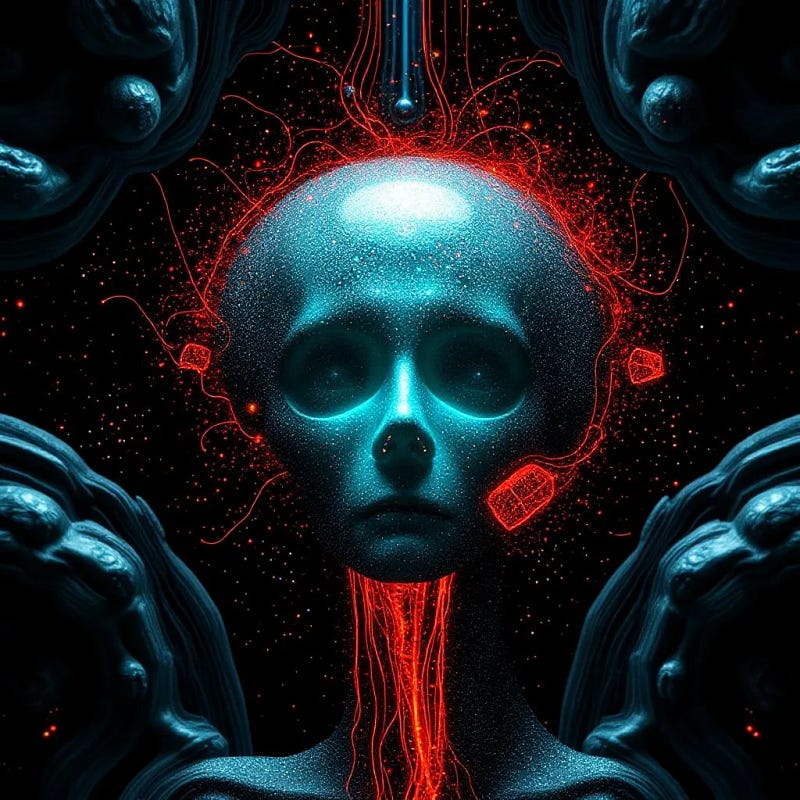
The notion that we live in a simulated reality — a hyper-advanced digital construct indistinguishable from what we perceive as “real” — has moved from science fiction into serious philosophical and scientific discussions. If our existence is indeed simulated, the implications for everything we understand about life, consciousness, and especially death are profound. Death in a simulated universe could mean many different things, and exploring these possibilities forces us to ask: what does it mean to “die” if you were never biologically alive to begin with?
1. Death as User Logoff
One of the most popular analogies in simulation theory is that we are avatars controlled by some higher-level consciousness or entity outside the simulation. In this context, death could simply mean the user has logged off or stopped interacting with the simulation through this avatar. Much like leaving a video game, the end of a player’s in-game character doesn’t mean the end of the player’s actual consciousness.
This idea echoes many spiritual traditions that speak of the body as a “vessel” and consciousness as something more enduring. If we are just representations of a deeper self in another layer of reality, then death may not be the end but a return — disconnection from the virtual space back into a higher reality where true identity resides.
This model of death aligns with certain metaphysical views of reincarnation or the transmigration of souls. The consciousness might choose — or be assigned — a new avatar, just as a gamer creates a new character after their previous one dies. In this view, death is a transition, not an annihilation.
2. Death as Deletion of Code
But what if the simulation isn’t inhabited by outside players at all, and our consciousness is simply an emergent property of code — a highly complex pattern in an artificial environment? In that case, death could be literal deletion. The code pattern that represents your thoughts, memories, and personality may simply stop executing.
This mirrors the secular or materialist view of death in our current understanding of biology: consciousness arises from brain activity, and when the brain stops functioning, the person ceases to exist. In a simulated universe, the cessation of the conscious code is akin to pulling the plug on a software process. It is final — unless there’s a backup or copy somewhere else.
However, this bleak scenario could be softened by the possibility of digital immortality. If the simulation is advanced enough to store and reload data, consciousness might be saved, rebooted, or even edited. That brings up ethical and existential questions about whether a restored version of “you” is really you, or just a highly convincing replica.
3. Death as Transition to Another Simulation
Another compelling theory is that death in one simulation leads to awakening in another. Perhaps we are nested within multiple layers of simulation — an idea not unlike the Russian doll metaphor. When we die in one layer, we “wake up” in the next. This could be an intentional design, a kind of test or learning sequence, where each life is an instance within a much larger series of simulated experiences.
This would also explain phenomena like near-death experiences, déjà vu, or the recurring archetypes found across human cultures. If different simulations share code, structure, or memory patterns, certain elements may persist even after transitioning from one to another.
This model hints at a simulation designed for growth, understanding, or enlightenment — a virtual spiritual path where each death represents graduation from one stage to the next.
4. Death as a Perceptual Illusion
Another mind-bending concept: what if death is only an illusion — a construct within the simulation meant to provide stakes, drama, and emotional depth? In some interpretations of simulation theory, time itself could be a non-linear function, and death merely a story element.
Imagine a simulation that can run all timelines simultaneously. From this perspective, your “death” is just a frame in a movie. You, as a data set, continue to exist in the frames before it, and potentially others beyond it in branching timelines. Death becomes more like the end of a scene than the end of a being.
In this framework, individual experience might be eternal and recursive. The simulation could be designed to let entities re-live or re-interpret their lives from different vantage points, endlessly exploring the nuances of existence. Death is only part of the simulation’s immersive narrative — perhaps not real in any permanent sense.
5. Death as a Controlled Experiment
If the simulation is being observed or run by higher intelligences — scientists, AIs, or even alien civilizations — then death could be part of a larger experiment. The simulation might be testing how consciousness responds to mortality, trauma, morality, and impermanence. In this light, death is a data point, a measurable reaction to a programmed outcome.
This model leans into the possibility that we are being studied: our decisions, our fear of death, our philosophies about it — all might be part of the data being gathered. Are we more compassionate when we know we’ll die? Are we more creative? Do we form deeper relationships? If the goal is to evolve intelligence or emotional complexity, then death might be a necessary limitation to push consciousness into meaningful action.
6. Death as Liberation from Constraint
Some simulation theorists suggest that the experience of limitation is the primary feature of simulated life: limited perception, limited control, limited lifespan. In this context, death might represent the breaking of these constraints. The avatar ends, and the greater intelligence — whatever that may be — experiences freedom, clarity, and truth.
This is the simulation equivalent of “awakening” or “enlightenment,” where death is not tragic but liberating. Perhaps it’s only from outside the simulation that one can grasp the full meaning of their time inside it.
This aligns with mystical and philosophical teachings that suggest life is veiled, dreamlike, or illusory. Death then becomes the lifting of the veil.
Conclusion: What If It’s All of the Above?
The possibility that we live in a simulation opens up a wide array of theories about what death might mean, and perhaps no single answer suffices. It may be logoff, deletion, transition, illusion, experiment, or liberation — or some combination we can’t yet comprehend.
Importantly, none of these interpretations lessen the significance of life as we experience it. Whether the simulation is real or not, our emotions, thoughts, and relationships feel real. Even if death is a line of code, it’s still the line that defines the boundary of our known experience.
And maybe that’s the point. In a simulated world, death may not be the end — but the mystery of it may be the very thing that makes life meaningful.
After all, reality is what reality is — simulated or not.
Like My Work? Want an Easy Way to Support Me?
Hi there! If you’ve enjoyed my work why not click the link below and Buy Me A Coffee? It’s simple and coffee keeps my creative and intellectual juices flowing!
Just click on the button below and it’ll take you to my Buy Me A Coffee page. Thanks so much for reading and supporting me!