
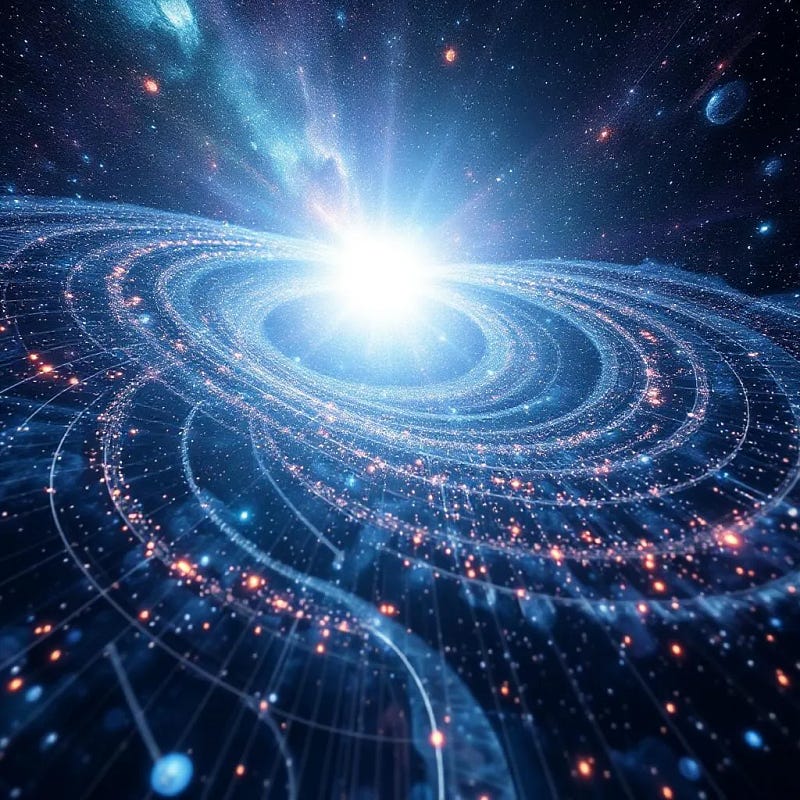
The notion that our universe might be a simulation — an artificial construct orchestrated by an advanced intelligence or future civilization — has captivated scientists, philosophers, and technologists alike. Central to this hypothesis is the concept of space-time itself. If reality as we perceive it is simulated, then the very fabric of space-time — its continuity, dimensionality, and behavior — might be the result of deliberate design decisions or computational constraints rather than fundamental laws of physics. This idea invites an expansive exploration of what space-time might actually be within such a simulated framework. Not merely a passive backdrop, space-time in a simulation could be malleable, conditional, or even illusory.
Space-Time as a High-Fidelity Approximation
One possible scenario is that simulated space-time is a strict approximation of our conventional understanding. In this framework, the simulation mimics the observable universe with high fidelity, using a grid or mesh of computational nodes that emulate continuous space. Time might be processed as discrete ticks or frames, similar to frames in a video game engine, with each moment calculated and rendered as needed. Quantum uncertainty and relativity could be clever artifacts of rendering constraints or optimizations to conserve resources — only resolving precise locations or velocities when observed. This aligns with the idea that “reality” becomes determinate only upon measurement, much like how a video game loads environments only when the player approaches them.
Non-Euclidean and Subjective Constructs of Space-Time
Alternatively, space-time in a simulation could be fundamentally different from our perceptions. The “rules” we observe may not be constraints of nature but constructs of software — arbitrary, even playful. For instance, the simulation could run on a non-Euclidean architecture, where the true geometry of space is non-intuitive and merely translated into a familiar 3D space for the benefit of the consciousnesses experiencing it. In this version, the spatial relationships we perceive are interpretative renderings — decisions by the simulation engine to simplify interaction or to stabilize the subjective experience of inhabitants. Time, too, might not be linear or uniform. Some observers within the simulation might experience loops, jumps, or divergent flows of time, either as part of experiments or due to flaws in the simulation’s temporal rendering protocols.
Event-Driven Reality and Emergent Space-Time
Another compelling scenario is that space-time is emergent within the simulation, not a pre-existing grid. In this possibility, the simulation is event-driven, and space-time is dynamically generated by interactions between entities or agents. Nothing exists in the simulation until it is needed — no stars exist until observed, no past until remembered, and no future until imagined. This is not just an efficiency strategy but a fundamental statement about the nature of reality within the system. Space and time are therefore not universal constants but contextual variables, perhaps differing drastically between agents or locations. What one observer experiences as continuous time may appear disjointed or asynchronous to another. Here, consensus reality is negotiated in real time among conscious entities, much like how multiple players in a multiplayer game must agree on the current state of the game world.
Hidden Dimensions and Background Processes
There is also the possibility that simulated space-time includes hidden dimensions or physics inaccessible to ordinary perception. These extra parameters may govern or influence the behavior of the simulated world from “beneath” the apparent reality — like secret developer tools running in the background of a game engine. Such hidden space-time dimensions could be used for optimization, parallel processing, or even administrative oversight by whatever intelligence operates the simulation. This might manifest as unexplained phenomena in our world: quantum entanglement, non-locality, or even the feeling of déjà vu. These could be signs of background recalibrations, interventions, or updates happening “outside” our layer of simulation.
The Logic-Based Simulation: No Space, No Time
A more radical vision is that space-time is not merely simulated but metaphorical. In this scenario, the simulation does not run in any spatial sense at all. There is no “where” or “when” the simulation exists — it is instantiated in logic, like a vast mathematical proof being evaluated across computational abstraction. In this view, space and time are user interface constructs to enable the navigation of logical relationships. The mind, being part of the simulation, interprets these relationships as movement through space or passage through time. This turns causality itself into a narrative device — a mental way of experiencing correlations and state changes that have no inherent temporality. Reality, then, is not a place but a process, a structured unfolding of propositions, evaluated moment by moment according to an internal syntax.
Layered Simulations and Recursive Space-Time
Consider also the possibility that the simulation is layered — nested like Russian dolls. Within such a system, space-time in our universe may itself be the simulation of another simulated space-time. Entities in our universe might build their own simulations, each with its own set of physics and spatial logics. Each layer could possess its own version of space-time, distinct in dimensionality or behavior, yet inherited in part from the layer above. Glitches or anomalies could be signs of cross-layer interference, like echoes from parent simulations or inconsistencies introduced by recursive feedback. In this sense, our understanding of space-time could be akin to interpreting shadows in Plato’s cave — faithful only within our limited perspective.
Space-Time as a Framework for Consciousness
Some theorists propose that space-time could function like a neural architecture — an information-processing system optimized not for simulating a world, but for cultivating consciousness. The geometry and flow of time are not emulating physical reality but enabling computational awareness. Space becomes a network of potential states, and time becomes the ordering of awareness through them. Reality then is shaped not by particles moving through a void but by experiential nodes linking conscious events. This could explain why certain phenomena — like synchronicity or altered states of perception — appear to bend space-time in subjective but meaningful ways. The simulation might be goal-oriented, adjusting space-time dynamically to facilitate growth, understanding, or some unknown directive.
The Theatrical Set Model: Space-Time as Illusion
Of course, it’s also possible that space-time in the simulation is ultimately a fiction — there is no space-time, no “simulation” as we understand it, but rather an unknowable substrate rendering a continuous stream of coherent, causally-connected sensory input. In this model, the experience of space-time is a theatrical set, a consistent illusion for embodied consciousnesses to move through a narrative of existence. Just as a character in a dream does not know they are dreamt, we may be wandering a curated dreamscape, programmed not for accuracy but for believability, with just enough mystery to keep us seeking.
Meaning as the Core of Simulated Space-Time
In all these possibilities, one theme emerges: if we live in a simulation, then space-time is not a given. It is a medium, perhaps even an intentional act — a kind of language, designed not just to represent but to condition experience. The flexibility of that language, its ability to mimic continuity, break apart into discrete chunks, fold in on itself, or entirely vanish under scrutiny, reflects the power — and the limitations — of the system that sustains it.
Whether space-time is a grid, a web, a dance of data, or a fabrication of consciousness, its simulated nature would force us to reconsider our most basic assumptions. It would suggest that reality is not an objective domain waiting to be measured, but an ongoing dialogue between perception and code — between the seen and the scripted. In such a universe, perhaps the true nature of space-time isn’t about dimensions or duration, but about meaning: the patterns we extract from the illusion, and the truths we create within it.
Like My Work? Want an Easy Way to Support Me?
Hi there! If you’ve enjoyed my work why not click the link below and Buy Me A Coffee? It’s simple and coffee keeps my creative and intellectual juices flowing!
Just click on the button below and it’ll take you to my Buy Me A Coffee page. Thanks so much for reading and supporting me!