
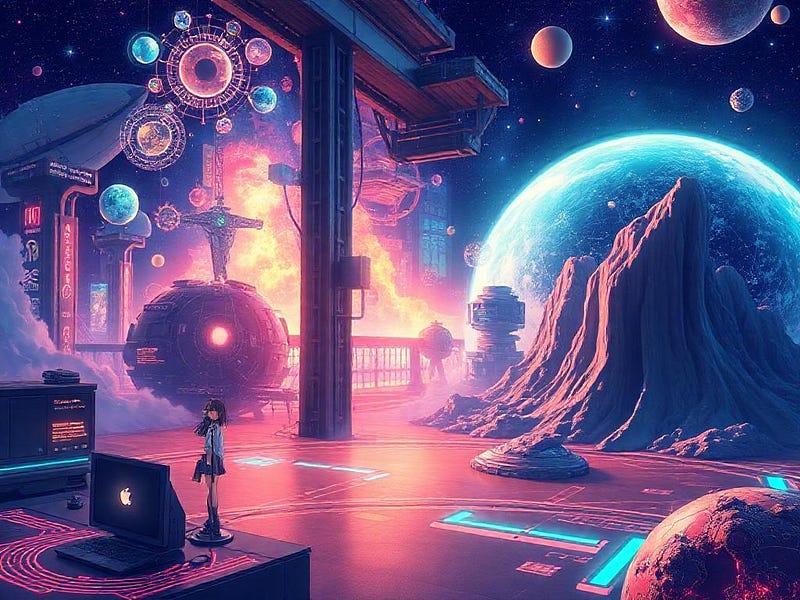
In the sprawling universe of ideas that challenge our assumptions about reality, few are as disorienting, or as intellectually thrilling, as the Simulation Hypothesis. The notion that our universe might be an elaborate computational construct, running on a substrate different from what we perceive as physical reality, has evolved from fringe speculation to serious philosophical inquiry. And at the heart of this hypothesis lies a deeply provocative concept, the substrate-independence of consciousness.
This idea, that consciousness does not depend on a specific kind of physical matter but rather on the patterns and processes occurring within it, has gathered support from thinkers across multiple disciplines. Philosophers like David Chalmers, physicists like Max Tegmark, futurists like Ray Kurzweil, and theorists like Nick Bostrom and Rizwan Virk all engage with this theme, each contributing a piece to a mosaic that challenges the very fabric of how we understand mind, matter, and existence itself.
What Is Substrate-Independence of Consciousness?
To grasp the implications of substrate-independence, it helps to start with the basics. The idea posits that conscious experience is not inherently tied to biological neurons or carbon-based life forms. Instead, consciousness may emerge from any system that implements the right kind of informational or computational patterns. Whether that system is made of neurons, silicon chips, or something far stranger is beside the point, what matters is the organization and dynamics of the information processing.
David Chalmers, a leading voice in the philosophy of mind, has argued extensively for the “organizational invariance” of consciousness. He suggests that if a silicon-based system duplicates the functional organization of a human brain closely enough, there is no good reason to deny that it would also replicate conscious experience. In other words, the medium doesn’t matter, only the message and how it is structured. This view aligns with what Chalmers calls a “computational theory of mind,” in which mental states are akin to software running on various forms of hardware.
Max Tegmark, in Life 3.0, takes this further by suggesting that consciousness may be a form of information processing that is ultimately governed by the laws of physics. He introduces the notion of “perceptronium,” the most general substance that can feel subjectively, arguing that consciousness arises from certain patterns of information that obey specific mathematical rules. These ideas move the conversation from speculative philosophy to a kind of “physics of consciousness,” where the architecture of experience is a byproduct of complex computation rather than specific material.
This conceptual leap is essential when considering the Simulation Hypothesis, particularly in its modern, probabilistic formulations.
The Simulation Hypothesis and Its Philosophical Stakes
Nick Bostrom’s 2003 paper “Are You Living in a Computer Simulation?” laid the groundwork for serious academic discourse on the topic. Bostrom proposed a trilemma, either (1) civilizations never reach a post-human stage capable of running high-fidelity ancestor simulations, (2) post-human civilizations are not interested in running such simulations, or (3) we are almost certainly living in one.
This third proposition hinges on the assumption that it’s possible to simulate minds like ours with enough detail to produce conscious experience. If substrate-independence holds, then simulating a mind down to its functional structure should be sufficient to instantiate a conscious being within a simulation. This is a crucial link, the Simulation Hypothesis collapses without the presumption that consciousness can arise in computational systems other than biological brains.
Bostrom himself acknowledges this. In a lesser-discussed section of his argument, he notes that if consciousness is not substrate-independent, if it does depend on biological matter or some unknown physical property, then even perfect simulations of human minds might not result in actual subjective experience. In such a case, simulations would be mere puppets, acting as if they were conscious, but without any inner life. That would render the Simulation Hypothesis moot as a metaphysical explanation of our own consciousness, relegating it to an elaborate performance without subjectivity.
Digital Physics and Conscious Agents
Substrate-independence also fits within the broader framework of what Max Tegmark calls the “Mathematical Universe Hypothesis.” Tegmark argues that our reality is a mathematical structure, not just described by mathematics. If true, this would imply that the computational processes underlying our consciousness are embedded in the very geometry of the cosmos, suggesting that simulating consciousness might be less of an emulation and more of a direct instantiation.
Rizwan Virk, in The Simulation Hypothesis, adds another dimension by drawing from both digital physics and Eastern philosophical traditions. He notes that just as a video game renders only what is necessary for the player’s experience, our universe may be rendering only what is observed. This idea echoes quantum mechanical interpretations where observation seems to “collapse” wave-functions into reality. If the universe is an efficient simulation, and our minds are conscious observers within it, then their substrate must be compatible with the underlying computational framework of the simulation.
Virk also emphasizes the increasing plausibility of the hypothesis through advances in virtual reality, AI, and neural networks. As we build systems that can mimic human cognition, and even emotion, it becomes harder to insist that consciousness requires biology. The more realistic our simulations become, the more plausible it seems that consciousness could arise in them, provided the right structural and dynamic conditions are met.
Kurzweil, AI, and the Approaching Singularity
Ray Kurzweil, known for his work on technological singularity and transhumanism, adds a future-facing view to this discussion. He believes we are rapidly approaching a point where artificial intelligence will surpass human intelligence. But for Kurzweil, intelligence and consciousness are deeply entwined, and he maintains that as we replicate the brain’s processes in machines, we will also recreate its capacity for consciousness.
In his book The Age of Spiritual Machines, Kurzweil describes a future where minds can be uploaded, extended, and duplicated across various substrates. This vision only makes sense if we accept that consciousness does not depend on a specific set of biological conditions. Instead, it’s the pattern and continuity of information processing that matters. As such, a person “uploaded” to a digital environment would retain their identity and subjective continuity, because the substrate doesn’t matter, only the software does.
Such ideas dovetail perfectly with the Simulation Hypothesis. If we, in the future, can simulate minds in silicon or even quantum substrates, then a more advanced civilization could already be doing the same, with us as the simulations.
Implications, Epistemology and Identity in a Simulated World
Accepting substrate-independence not only gives the Simulation Hypothesis philosophical coherence, it also shakes the foundations of what it means to know anything. If conscious experience can arise in any sufficiently complex substrate, then simulations can house beings as real (to themselves) as we are. This raises immediate questions about identity, ethics, and our place in the cosmos.
What makes a person real? Is it the continuity of subjective experience, regardless of the medium that sustains it? If so, the barrier between “real” and “simulated” dissolves. There’s no metaphysical difference between a consciousness running on neurons and one running on quantum circuits or exotic matter matrices, both are equally valid experiences from the inside.
This is perhaps the most unsettling implication of substrate-independence, the potential universality of mind. It doesn’t just make simulations plausible, it makes them inevitable, if any civilization has sufficient computational capacity and a reason to create them. And if those simulated beings are conscious, then questions of morality, free will, and even afterlife take on entirely new meanings.
The Universal Mind and the Mirror of Reality
Substrate-independence of consciousness is more than just a philosophical proposition, it’s the linchpin that binds together theories from artificial intelligence, physics, and metaphysics. It provides the necessary groundwork for treating consciousness as an emergent phenomenon of information processing, rather than a byproduct of organic chemistry. In doing so, it breathes serious credibility into the Simulation Hypothesis, shifting it from late-night dorm room speculation into the realm of rigorous, if still speculative, inquiry.
Whether or not we are living in a simulation remains an open question. But if we are, if our minds exist within some vast computational architecture, then substrate-independence may be the very principle that allows us to ask these questions in the first place.
In that sense, our curiosity, our thoughts, our doubts about the nature of reality, are themselves evidence of the hypothesis. Not because we can see the code, but because the code can, in some strange way, see itself.
Like My Work? Want an Easy Way to Support Me?
Hi there! If you’ve enjoyed my work why not click the link below and Buy Me A Coffee? It’s simple and coffee keeps my creative and intellectual juices flowing!
Just click on the button below and it’ll take you to my Buy Me A Coffee page. Thanks so much for reading and supporting me!