
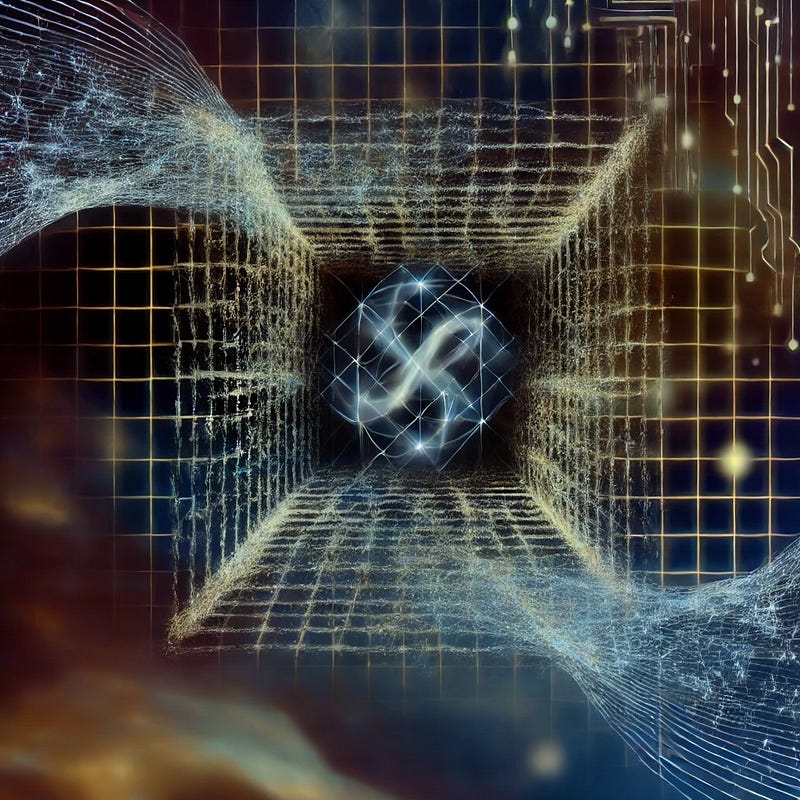
By now, the Simulation Hypothesis has seeped into popular culture; thanks in no small part to films like The Matrix and musings from tech titans like Elon Musk. The idea is tantalizing: what if everything; our thoughts, our memories, the vast star-filled sky; is all just part of a hyper-advanced computer simulation? While some dismiss it as stoner philosophy or science fiction, physicist Max Tegmark doesn’t so easily wave it away. In Life 3.0: Being Human in the Age of Artificial Intelligence, Tegmark lays out a serious, nuanced take that elevates the discussion beyond dinner-table banter and into the realm of thoughtful, scientific inquiry.
Tegmark’s exploration begins with a seemingly simple, but revolutionary, concept: the substrate-independence of consciousness. This is the idea that consciousness doesn’t require a specific biological “wetware” like the human brain. If the right kind of information processing happens; regardless of whether it’s on neurons, silicon chips, or something even more exotic; then consciousness can, in principle, emerge. To Tegmark, this isn’t speculative hand-waving. It’s an extension of functionalism in cognitive science and neuroscience, which holds that what matters for mental states is how information is processed, not what it’s processed on.
This view forms a cornerstone of Tegmark’s take on the Simulation Hypothesis. If minds can emerge on any sufficiently complex substrate, then it follows that digital minds, such as those inside a simulation, could be just as real as our own. If consciousness can be encoded in bits and logic gates as easily as in gray matter and synapses, then simulated beings might not think they’re real. They are real, at least from their own point of view. That alone should make us reconsider what we mean by “real.”
But Tegmark doesn’t stop at metaphysics. He moves into what he calls the levels of simulation; borrowing an idea from philosopher Nick Bostrom, but expanding on it. We can imagine simulations running inside simulations, each potentially oblivious to the artificiality of their world. This raises a dizzying but logical question: how would we know whether we’re in the “base” reality or some deeply nested simulation?
Here, Tegmark turns to statistical logic. He proposes that if any civilization ever becomes capable of running realistic simulations of conscious beings and has the computational appetite to do so, it’s likely they would run many such simulations. After all, running a simulation might be relatively cheap compared to maintaining a biological society. If each real civilization spawns thousands or millions of simulated ones, then, purely statistically, most conscious minds would exist inside simulations. By this logic, the odds that we’re in base reality dwindle significantly. It’s not a guarantee, but it’s a provocative, unsettling shift in perspective.
Still, it’s not enough to assert that simulations could exist. We also need to know how they might work. Here, Tegmark leans into his background in theoretical physics and his own Mathematical Universe Hypothesis. In short, Tegmark believes that our universe is a mathematical structure; it is not merely described by math, but made of math. Every physical entity, from electrons to galaxies, is simply a component of some grand mathematical equation unfolding over time.
From this view, simulations don’t need to emulate reality; they are reality, just playing out on a different mathematical substrate. If the equations that govern a simulated world are internally consistent and capable of supporting self-aware observers, then there’s no meaningful difference between that simulation and what we typically call a universe. It’s not that simulated beings think they are alive in a world of consistent laws; they are alive in a world of consistent laws. The distinction between simulation and reality begins to evaporate.
This brings us to an important technical consideration: computational power and physical limits. Could a civilization, even a hyper-advanced one, ever simulate a universe as complex as our own? Tegmark acknowledges that simulating every detail of an entire cosmos might be infeasible. But he also suggests that total fidelity might not be necessary. Much like a video game that only renders what the player can see, a simulation could conserve resources by dynamically generating details only when observed. This principle, sometimes called “lazy rendering,” could drastically reduce the needed processing power.
Quantum mechanics even seems to echo this idea. At the subatomic level, properties like the position of a particle remain undefined until measured; almost as if the universe is resolving its state only when someone is looking. Tegmark doesn’t claim this is proof we’re in a simulation, but he does note the eerie parallel. If our world were a simulation, quantum indeterminacy might not be a bug; it could be a clever feature to save computing resources.
Moreover, Tegmark draws attention to the way physical laws themselves can be thought of as algorithms. From the Standard Model of particle physics to Einstein’s equations of general relativity, the universe seems suspiciously elegant; far more streamlined than we’d expect from chaotic happenstance. If nature is governed by clean, computable rules, then maybe it’s because it is being computed.
So where does this leave us? Tegmark doesn’t argue that we are definitely living in a simulation. Instead, he urges us to take the possibility seriously; not just as a philosophical parlor trick, but as a real hypothesis with scientific implications. If we are in a simulation, then someone built it, and their choices determine the rules of our existence. That opens up profound questions about agency, purpose, and what happens when the simulation ends or is switched off.
But Tegmark also underscores the implications for how we behave. If there’s a chance we’re in a simulation, should that change how we live our lives? For some, it might induce despair. Why bother, if it’s all artificial? But Tegmark sees the inverse; a reason for hope. If simulations are run by advanced civilizations, they might be watching for moral or intelligent behavior. Maybe how we act, individually and collectively, determines whether our simulation gets expanded, preserved, or deleted. Perhaps living ethically is not just good in itself but part of passing some cosmic test.
There’s also a humbling lesson here. If we’re simulated, then we are not the ultimate beings in existence. Just as ants cannot comprehend the internet, we might be blind to higher layers of reality. That doesn’t diminish our worth, Tegmark argues; it expands our curiosity. We may not have all the answers, but we’re part of a process, a search for understanding, that stretches beyond the boundaries of our universe.
In the end, Tegmark’s take on the Simulation Hypothesis isn’t about paranoia or escapism. It’s about taking seriously the deep questions that physics, consciousness, and computation raise when we let them collide. Whether or not we’re living in a simulation may never be provable with certainty. But the very act of asking forces us to think more carefully about what we mean by real, what we value in existence, and how we might matter in the grand, possibly simulated, scheme of things.
Like My Work? Want an Easy Way to Support Me?
Hi there! If you’ve enjoyed my work why not click the link below and Buy Me A Coffee? It’s simple and coffee keeps my creative and intellectual juices flowing!
Just click on the button below and it’ll take you to my Buy Me A Coffee page. Thanks so much for reading and supporting me!