
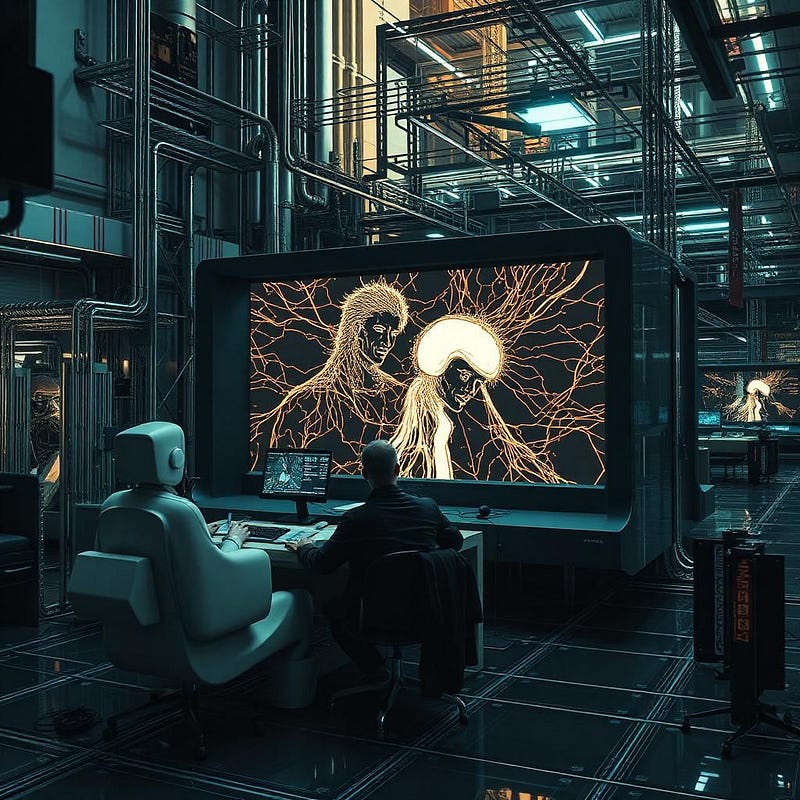
The idea that reality might be a simulation has been floating around philosophy for a long time. It pops up now and then, usually in science fiction or the occasional essay, but it rarely feels like something that matters in everyday life. At the same time, large language models have gone from being a curiosity to something people actually use. They help write, code, research, and even keep people company. What’s interesting is not just that both things exist, but that they’re starting to overlap in a way that feels more tangible than it used to.
LLMs are not conscious, but they are very good at simulating parts of cognition. They respond to language with language, keep track of context, and produce answers that feel intentional. On the surface, it can feel like you’re interacting with something that understands you. But underneath, there is no awareness, just patterns learned from enormous amounts of text. That gap between how something feels and what it actually is starts to matter. If something can convincingly simulate intelligence without having it, then the line between real and simulated begins to blur, at least from the inside.
The Simulation Hypothesis suggests that reality itself could be something similar, an artificial construct running on some deeper layer we do not see. Philosophers like Nick Bostrom have framed it as a probability question. If advanced civilizations can run huge numbers of simulations, then statistically it becomes more likely that we are in one than in a base reality. For a long time, that idea has felt distant. It is interesting, but it does not connect to anything you can actually experience. LLMs change that a little, because now we have something we can interact with that behaves like a kind of constructed reality.
When you talk to an LLM, you are engaging with something that feels coherent and meaningful, but is ultimately built from fragments. It does not retrieve knowledge in the way a person does. It rebuilds it in real time. In a sense, it generates a kind of reality made out of language. It is consistent enough to be useful, but it is still grounded in probability, not truth. That starts to raise a deeper question. If our own experience of the world is also mediated through patterns, neurons firing, signals being interpreted, then how different is that structure from what the model is doing?
One way to look at it is that LLMs strip intelligence down to something more mechanical than we like to admit. Human thought feels rich and grounded, but a lot of it is predictive. We fill in gaps, anticipate outcomes, and tell ourselves stories about what is happening. LLMs do a rough, simplified version of that. The resemblance is not perfect, but it is close enough to be a little uncomfortable. It suggests that what feels like direct experience might actually be more like a rendering, an interface layered over something deeper.
There is also a kind of role reversal happening. Usually, the Simulation Hypothesis puts us in the position of the simulated, unaware of the system running us. With LLMs, we are the ones building the system. We can see exactly where it breaks. It hallucinates, contradicts itself, and sometimes misses connections that seem obvious. Those failures are not just flaws, they are informative. They give us a sense of what a simulated system looks like when it is not perfect. If our own reality were simulated, it might not be flawless either. It might include inconsistencies, edge cases, or things that simply do not resolve cleanly.
Another piece of this is meaning. LLMs can produce text that feels meaningful, sometimes deeply so, even though there is no understanding behind it. The meaning does not live in the system. It emerges in the interaction. That is an important shift. If meaning can come out of a system that does not inherently contain it, then maybe meaning does not require the kind of grounding we assume it does. Applied to the Simulation Hypothesis, that suggests something simple but significant. Even if reality were simulated, it would not necessarily feel any less real from the inside. Experience would still be experience.
At the same time, LLMs make it clear that simulation has limits. They can sound confident and still be wrong. They can lose track of things or fail to connect ideas that a human would catch immediately. These breakdowns matter because they show the difference between approximation and equivalence. A system can simulate something convincingly without actually becoming it.
That tension is where things get interesting. LLMs do not prove that we are living in a simulation, and they do not really make it more likely. What they do is make the idea easier to grasp. They give us something concrete to point at, something that shows how a system can feel real and meaningful without being grounded in the way we expect.
So the question shifts a bit. Instead of asking whether this is real, it becomes more useful to ask what we mean by real in the first place. If something can generate an experience that is indistinguishable from reality, then the distinction may not matter as much as we think. Or, put more simply, reality is what reality is, regardless of what it runs on.
Like My Work? Want an Easy Way to Support Me?
Hi there! If you’ve enjoyed my work why not click the link below and Buy Me A Coffee? It’s simple and coffee keeps my creative and intellectual juices flowing!
Just click on the image below and it’ll take you to my Buy Me A Coffee page. Thanks so much for reading and supporting me!