
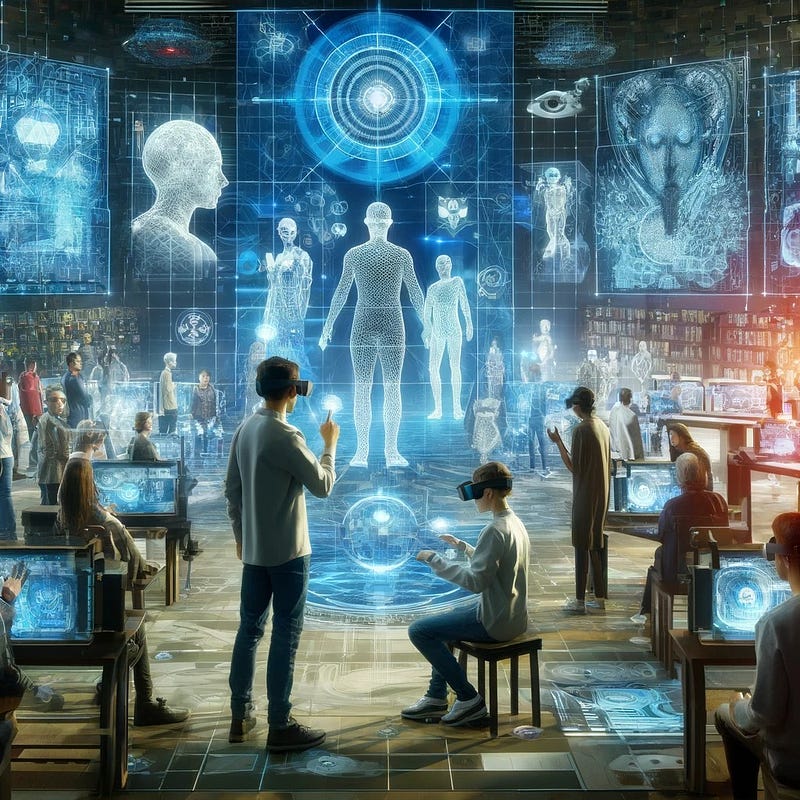
The simulation hypothesis posits that our reality might be an artificial simulation, such as a computer-generated environment. Since January 2024, several breakthroughs have emerged that provide new insights and fuel further discussion on this intriguing topic. Below, we delve into these developments, highlighting their implications and the scientific discourse they’ve engendered.
1. The Second Law of Infodynamics
A significant breakthrough in the simulation hypothesis was introduced by Dr. Melvin Vopson with the formulation of the “second law of infodynamics.” According to his research, unlike traditional thermodynamics where entropy generally increases or remains constant, information systems might exhibit a different behavior where entropy can actually decrease. Dr. Vopson suggests that this anomaly could indicate our universe operates more like a computational system that optimizes and reduces information entropy — a characteristic of simulated systems.
This law has not only implications for our understanding of physical laws but also lends weight to the simulation hypothesis by suggesting that our universe’s behavior could be analogous to computational processes designed to conserve processing power and memory, much like a computer simulation.
2. Quantum Simulation Research
Further supporting the simulation hypothesis, a study led by Florian Neukart discusses the potential of quantum technologies to simulate complex systems. This research outlines how advancements in quantum computing could one day enable the creation of simulations that are indistinguishable from our perceived reality. The study discusses constraints and predictability within quantum systems, suggesting that observing these limitations could reveal whether we exist within a simulation chain.
This research points to a near future where quantum simulation could mimic complex systems so effectively that it might become feasible to test the simulation hypothesis empirically.
3. Cognitive Science and Perception
Adding a psychological dimension to the simulation hypothesis, Donald Hoffman has explored how our cognitive processes might actually be interpreting sensory data in a way that supports the simulation theory. Hoffman suggests that our brains could be processing information similarly to how a computer renders a simulation, proposing a model where what we perceive as reality is actually a user interface created by an underlying computational system.
This perspective intertwines cognitive science with the simulation hypothesis, suggesting that our everyday reality could be a construct designed to interact more efficiently with the external environment — possibly one that is computationally based.
Implications and Future Directions
These breakthroughs invite a deeper examination of the fundamental nature of reality, information, and consciousness. They also open up practical avenues for future research, where empirical methods could be devised to test the simulation hypothesis directly, such as observing the behavior of quantum simulations or investigating the computational nature of information processing in biological systems.
As these theories continue to be refined and tested, they could revolutionize our understanding of everything from physics and biology to philosophy and technology. Whether we are living in a simulation or not, these inquiries certainly enrich our grasp of the complex interplay between mind, matter, and reality.
The year 2024 has seen substantial progress in the investigation of the simulation hypothesis, bringing it from the fringes of speculative theory closer to a domain where it can be empirically evaluated. As we move forward, the intersections of technology, quantum physics, and cognitive science are expected to reveal even more about the profound and mysterious nature of our universe.
Each of these areas not only pushes the envelope in their respective fields but also collectively challenges our deepest notions about what is real, urging us to consider possibilities once confined to the realm of science fiction.
Like My Work? Want an Easy Way to Support Me?
Hi there! If you’ve enjoyed my work why not click the link below and Buy Me A Coffee? It’s simple and coffee keeps my creative and intellectual juices flowing!
Just click on the button below and it’ll take you to my Buy Me A Coffee page. Thanks so much for reading and supporting me!