
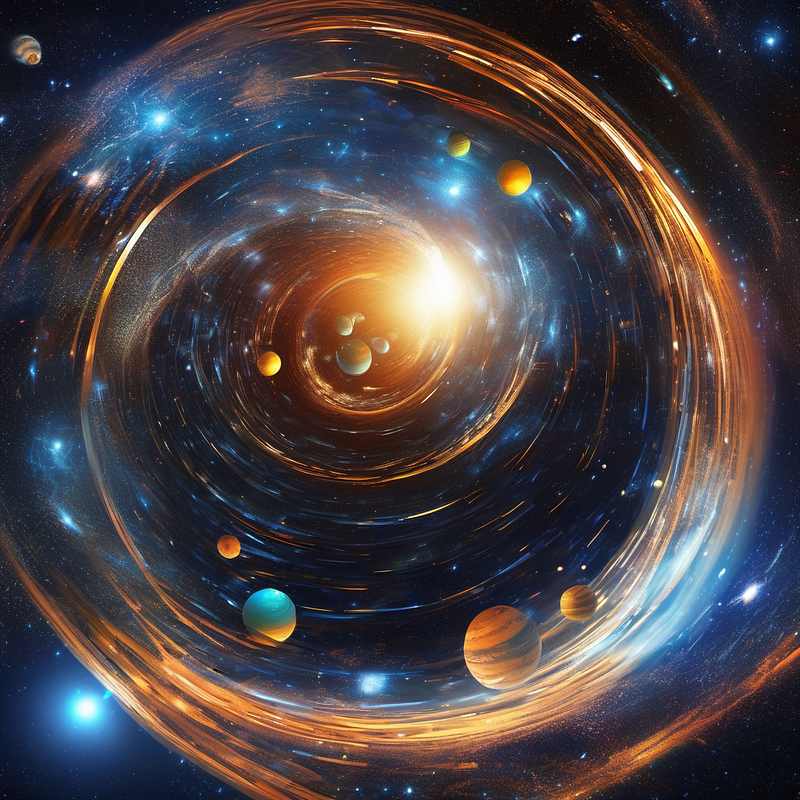
Time, a fundamental aspect of our existence, shapes our perception of reality and governs the unfolding of events in our lives. However, when viewed through the lens of a simulated reality, the concept of time takes on a complex and paradoxical nature. In this article, we will explore the intriguing challenges and problems associated with time within the context of a simulated reality.
Time as a Construct:
In a simulated reality, the very fabric of time may be a construct, a programmed feature designed to give the illusion of progression and continuity. This raises questions about the nature of time itself — is it an intrinsic property of the simulation, or does it merely serve as a perceptual tool for the simulated entities?
Simulation Lag and Temporal Discrepancies:
One potential problem with time in a simulated reality is the concept of simulation lag. If the simulation is governed by a complex computational process, there may be discrepancies in the perceived passage of time between the simulated entities and the underlying simulation. This could lead to temporal distortions and inconsistencies that challenge our conventional understanding of a linear timeline.
Predictive Programming and Deterministic Futures:
If our reality is a simulation, the idea of a predetermined future becomes plausible. The simulation’s creators, with advanced computational abilities, could potentially predict the trajectory of events, rendering the concept of free will and an open future illusory. This deterministic view of time introduces challenges to notions of choice, agency, and the unpredictability of human experiences.
Time Loops and Causality Paradoxes:
Simulated realities might give rise to temporal anomalies, such as time loops and causality paradoxes. If the simulation’s programming allows for recursive events or time travel, individuals within the simulation might find themselves trapped in loops or faced with paradoxes that defy our understanding of cause and effect.
Simulation Resets and Reboots:
The idea of a simulated reality raises the possibility of periodic resets or reboots, wherein the simulation is restarted to a previous state. This introduces the concept of cyclic time, where events and experiences repeat in a cyclical fashion, challenging the traditional linear progression of time.
Time Dilation and Perceptual Variances:
In a simulated reality, time dilation might occur, leading to variances in the perception of time among different entities. Some simulated entities may experience time at a faster or slower rate than others, introducing complexities in coordinating experiences and shared timelines.
Temporal Compression and Expansion:
The simulation’s programming could allow for temporal compression or expansion, altering the pace at which events unfold. This introduces the idea that time, as experienced within the simulation, is subject to manipulation, leading to shifts in the perceived speed or duration of events.
The problem with time in a simulated reality adds layers of complexity to our understanding of temporal dynamics. As we grapple with the implications of a simulated existence, questions about the nature of time, determinism, and the malleability of temporal experiences challenge us to reconsider the very fabric of our reality. The exploration of these temporal enigmas opens up a fascinating realm of philosophical inquiry at the intersection of simulated realities and the intricacies of the temporal dimension.