
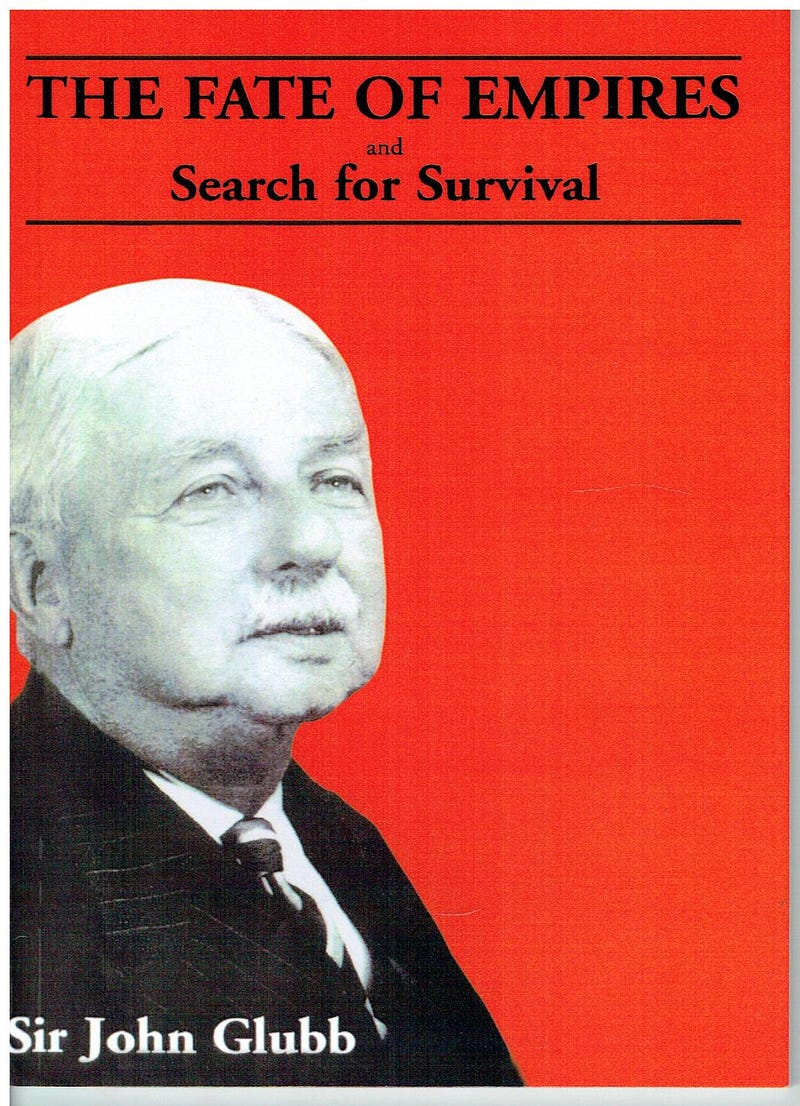
Sir John Glubb’s essay, “Fate of Empires,” provides a comprehensive examination of the rise and fall of empires throughout history. Drawing on his extensive knowledge of historical events, Glubb presents a cyclical pattern that characterizes the life cycle of empires, offering insights into the commonalities shared by civilizations that have faced similar fates.
Key Themes and Insights:
The Six Ages of an Empire:
Glubb identifies a recurring pattern consisting of six distinct ages that empires pass through:
- The Age of Pioneers
- The Age of Conquests
- The Age of Commerce
- The Age of Affluence
- The Age of Intellect
- The Age of Decadence
Common Characteristics of Decadence:
Glubb explores the characteristics that mark the Age of Decadence, a stage often associated with the decline of empires. These include political corruption, a focus on materialism, a decline in cultural and moral values, and an overreliance on bureaucracy.
The Role of Militarism:
Throughout the essay, Glubb emphasizes the crucial role of a strong military in the early stages of an empire. He argues that the decline often begins when military prowess gives way to an overemphasis on luxury, leading to the erosion of the empire’s initial strengths.
The Impact of Cultural Values:
Glubb delves into the influence of cultural values on the trajectory of empires. He suggests that a shift from a focus on duty and discipline to an emphasis on individual rights and hedonism contributes to the decline.
Warning Signs for Contemporary Empires:
While “Fate of Empires” was written in the mid-20th century, Glubb’s insights have been revisited as a lens through which to analyze contemporary societies. The essay serves as a cautionary exploration of potential pitfalls faced by modern nations.
Critiques and Considerations:
Sociocultural Context:
Critics argue that Glubb’s analysis might oversimplify the complex dynamics of empire-building and decline, neglecting the unique historical, cultural, and geopolitical contexts of each civilization.
Determinism vs. Adaptability:
Some scholars challenge the deterministic nature of Glubb’s framework, asserting that empires may possess the ability to adapt and overcome the challenges outlined in the essay.
Evolutionary Understanding:
Glubb’s model assumes a linear progression through the six ages, which might not capture the nuanced and dynamic nature of historical development.
Sir John Glubb’s “Fate of Empires” remains a thought-provoking and influential essay that invites readers to contemplate the cyclical patterns in the rise and fall of civilizations. While it may not offer a definitive blueprint for understanding the complexities of historical development, the essay provides valuable insights that continue to fuel discussions on the factors contributing to the fate of empires. Readers are encouraged to engage critically with Glubb’s work, considering its applicability to the analysis of both historical and contemporary societies.