
The Doorway You Never See: Gnosis, Timelines, and the Case for Living Without the Terror of Finality
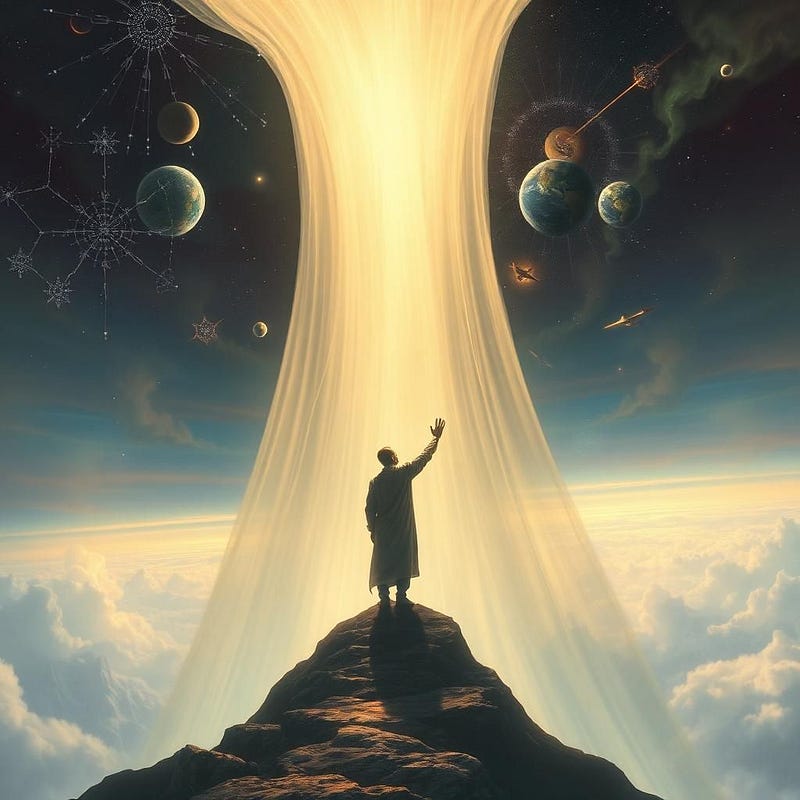
You’ve been told you can’t remember your birth and you won’t remember your death , two blanks that bookend a life that feels continuous only in the middle. The video whose transcript you shared uses that simple observation as a pry bar: if you never experience the edges, perhaps there aren’t edges in the way we imagine. Perhaps what we call “death” is not annihilation, but a shift, an unbroken thread of awareness passing into another scene of the same play.
This is a very old intuition. Gnostic writers described the material world as a veil and the human as a bearer of a “divine spark,” a witness that cannot be extinguished by time, illness, or accident. They wrote in the language of aeons and archons, of demiurges and doorways. Today we reach for different vocabulary — multiverses, branches, observers, yet the hope is recognizably similar: that the core “I am” behind the eyes persists.
What follows is a reconstruction of that thesis in clear terms, paired with what it means for fear, for meaning, and for intellectual honesty. The goal isn’t to convert you to a cosmology. It’s to show how an ancient lens and a modern imagination can meet without abandoning rigor, or comfort.
A River, Not a Line
Imagine your life not as a line but as a river delta: splitting, merging, endlessly branching. You feel yourself as one current, but the water is always moving, always finding a new channel. In the Gnostic idiom, most of us drift half-asleep, swept by tides we mistake for iron fate. The “archons,” whether read literally or as a metaphor for fear, ignorance, and conditioning, keep us looping. We forget our spark and attach to the scenery.
The modern update is to speak of “timelines.” At apparent endpoints, near misses, illnesses, accidents, your awareness does not “go dark.” It simply flows into another branch and continues. Sometimes, the speculation goes, you sense a seam: a déjà vu, an uncanny reprieve, a dream that feels like a memory with the serial numbers filed off. You didn’t survive against the odds; the branch you notice is the one in which you survived. In physics this family of ideas is called the Many-Worlds Interpretation (MWI). In internet folklore it sometimes gets dubbed “quantum immortality.”
We should pause here. It’s easy to confuse poetry with proof. Many-Worlds is a serious interpretation of quantum mechanics, but it does not, on its own, demonstrate personal consciousness hopping branches at death. “The observer decides reality” is a phrase more at home in mindfulness workshops than in textbooks. Still, as a metaphor for how awareness feels…central, continuous, strangely unbroken…it can do productive work.
What the Ancient Claims Get Right
Gnosticism is not one book or one dogma. It’s a chorus of texts, from Nag Hammadi manuscripts to patristic polemics, built around a pattern: the world as a theater of forgetting, the human as a sleeper with a spark, “gnosis” as a direct waking up to what can’t be taught secondhand. Read plainly, it’s less about pet cosmology and more about a skill: noticing the witness that remains when narrative quiets.
That noticing is not mystical fluff. If you take even five breaths and attend to the fact of awareness itself, you’ll find something calmer than the mind’s commentary. Practical counsel lives here: remember yourself throughout the day; ask “who is aware right now?”; interrupt your autopilot and choose deliberately; track dreams, intuitions, synchronicities…not to prove a theory, but to sharpen attention. Whether or not multiverses are literal, these habits tend to soften anxiety and increase agency. And if the fear under so much of our behavior is, in truth, a fear of ending, then practices that de-throne finality’s sting are not merely spiritual, they’re hygienic.
Where the Story Overreaches
The moment metaphors are stretched into mechanisms, trouble begins. The thesis that “you never die because you always shift to a branch where you live” quietly changes the subject from spiritual psychology to physics, and then cherry-picks the physics. Anecdotes about near-death experiences and déjà vu are evocative, but they wear their alternate explanations openly: neurochemistry under stress, memory’s fallibility, pattern-seeking minds. That doesn’t make them meaningless; it makes them insufficient as evidence of literal timeline travel.
There’s also a vagueness around the central character. When thesis mentions “you,” does it mean the autobiographical stream of memories and preferences, or the pre-conceptual witnessing which registers those contents? If it is the latter, the “silent observer” beneath narrative, then of course it doesn’t die in the way a story dies, because it isn’t a story. If it is the former, the you who likes jazz and black coffee, then the claim of survival becomes stronger and needs stronger support. Often, views keep both senses in play, leaning on the ambiguity for rhetorical power. That’s good poetry; it’s poor argument.
Finally, the historical conspiracy, empires and religions burying the truth because a people unafraid of death is ungovernable , contains a grain of plausibility and a loaf of projection. Texts were suppressed; movements were policed. Yet suppression alone doesn’t make a doctrine true, and a cleaner reading is available: beliefs that reduce fear can coexist with institutions without relying on a villain’s plot.
A Way to Hold It That Helps
If you’re looking for a clean verdict, “true” or “false”, you’ll be disappointed, because the claims bifurcate. As a scientific account of what happens when organisms perish, the thesis is speculative. As a spiritual practice, it is quietly powerful.
Begin with a minimalist move: treat the Gnostic frame as an existential tool. The idea that “endings are doors” immediately re-orders experience. Finality loosens its choke-hold; grief stays grief, but the despair beneath fear’s absolutism gets air. You still make your doctor’s appointments, lock your doors, wear your seatbelt, and love fiercely because life is finite in any frame that matters. But you stop living as if every loss is a verdict on whether it was worth showing up at all.
There is also a more rigorous, less metaphysical payoff: training attention toward the witness changes behavior. People who practice “remembering the observer” tend to be less reactive, more deliberate. They interrupt compulsive loops (archons as habit), and decisions tilt toward what they actually value. If you need a “proof,” begin there: it works on contact.
What Science Actually Offers…and Doesn’t
Physics, properly handled, is a humbler ally than many views suggest. Many-Worlds is one way to make sense of quantum theory’s equations: it posits a branching universe where all possibilities are realized. Whether consciousness rides those branches as a single enduring subject is not a claim physics makes; it’s a metaphysical add-on. Neuroscience, for its part, ties memory, self-modeling, and awareness to the brain with increasing detail. It does not yet dispatch consciousness as a solved problem, but it does demand that claims of personal survival answer to the abundance of evidence linking mind and matter.
So where does that leave the seeker who wants both comfort and clarity? With a two-handed stance: keep your metaphors, but label them; keep your curiosity, but don’t confuse evocative stories with empirical confirmation. Live with as if: as if endings are thresholds, as if attention is the key to agency, as if fear is less a tyrant than a habit. Then test these “as ifs” in ordinary days. You’ll know quickly if they help.
A Practice-Forward Coda
Some views culminate in gentle instructions, and speak very clearly, regardless of the view. A few are worth putting into your pocket without metaphysical pre-approval:
- Remember the witness. Several times a day, ask: Who is aware of this? Not as a puzzle, but as a way to feel the difference between the storm and the sky.
- Interrupt the script. Choose the left turn instead of the right, speak the truth you usually swallow, sit quietly where you would scroll. Each small deviation reminds the nervous system that you are not a passenger.
- Track the seams. Keep a light journal of dreams, uncanny coincidences, intuitive hunches. Don’t inflate them into proof; let them be bread crumbs that keep you curious and attentive.
- Rehearse reframes. When something ends, ask: If this is a doorway, what kind of presence do I want to carry through it? You may not believe in other timelines; you can still walk into the next room with more steadiness.
None of this requires a belief in demiurges or branches. It requires only a willingness to inhabit your life from the center instead of the edges.
A Balanced Verdict
As philosophy and myth, the “you never experience death” thesis is bracing and humane. It borrows a beautiful old grammar (gnosis, spark, veil) and pairs it with a modern imagination (timelines, observers) to argue that you are more than your biography. As science, it is mostly theater: the quantum talk is metaphor, not method; the evidence is experiential, not experimental; the key terms are under-defined.
But here is the quiet reconciliation: you don’t need to choose between comfort and clarity. You can reject the pseudo-physics and still keep the medicine. Live as if endings are doors. Practice remembering the witness. Use curiosity to sand the sharp edges of fear. If, in your last moment, it turns out that consciousness does carry on, into another room, another river branch, you will be meeting it with the same presence you cultivated all along. And if it does not, you will have used the only timeline you were sure of with more courage, attention, and love.
Either way, you win the part that mattered.
Like My Work? Want an Easy Way to Support Me?
Hi there! If you’ve enjoyed my work why not click the link below and Buy Me A Coffee? It’s simple and coffee keeps my creative and intellectual juices flowing!
Just click on the image below and it’ll take you to my Buy Me A Coffee page. Thanks so much for reading and supporting me!