
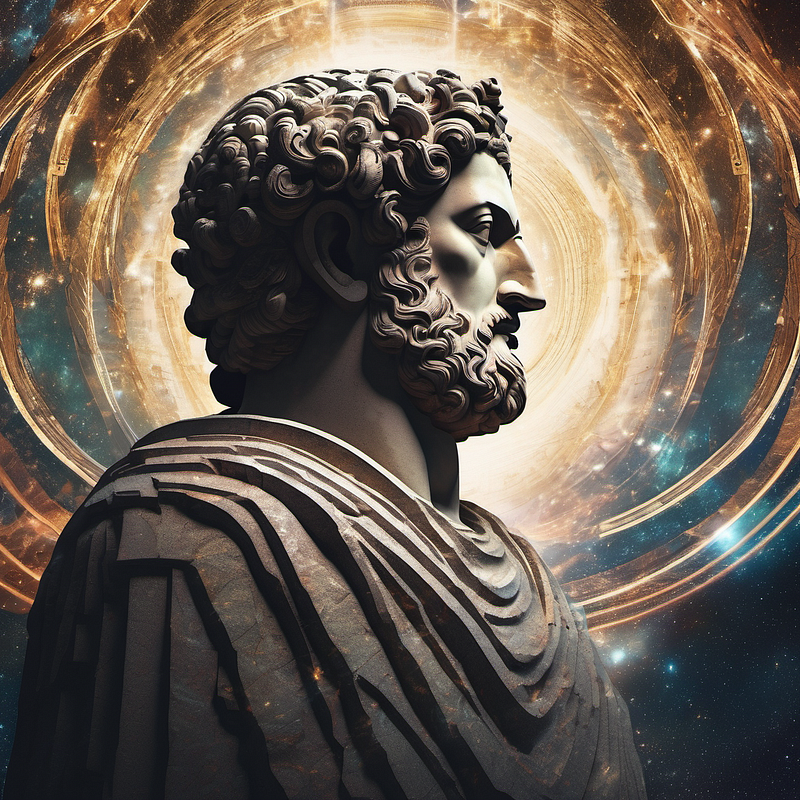
Stoicism, an ancient philosophical school that originated in Athens around 300 BCE, offers a framework for approaching life with tranquility and resilience in the face of adversity. As we contemplate the implications of the simulation theory — the idea that our reality is a sophisticated construct — we find a fascinating intersection with Stoic philosophy. In this article, we will explore the implications of simulation theory on the philosophical concepts of Stoicism, examining how Stoic principles may be applied to navigate existence within the context of a simulated reality.
The Illusory Nature of Reality:
Stoicism teaches that one must accept the nature of the external world and recognize that much of what we encounter is beyond our control. In a simulated reality, where the very fabric of existence may be illusory, Stoicism’s emphasis on acceptance aligns seamlessly. The Stoic sage, indifferent to the illusion of the external world, would find solace in the idea that the simulation itself is a neutral backdrop to their internal tranquility.
The Dichotomy of Control:
Central to Stoicism is the dichotomy of control, distinguishing between what is within our control and what is not. In a simulated reality, understanding the boundaries of control becomes even more crucial. Stoicism encourages individuals to focus on their thoughts, choices, and responses, echoing the idea that, regardless of the nature of the simulation, one’s internal state remains within their control.
Virtual Stoicism:
The simulated nature of reality raises the possibility that external events are orchestrated by a higher intelligence. In the Stoic tradition, facing a potentially predetermined or simulated existence, individuals could embrace a “virtual Stoicism,” emphasizing the cultivation of virtue and wisdom within the confines of the simulation. The pursuit of eudaimonia (flourishing) becomes a meaningful endeavor, regardless of the simulated context.
The Role of Reason:
Stoicism places a high value on reason as a guiding force for virtuous living. In a simulated reality, where the rules and laws of the universe may be programmed, the Stoic reliance on reason aligns with the quest to understand the simulated framework. Stoicism encourages individuals to use reason to navigate challenges, even if those challenges arise from the intricacies of a simulated construct.
Facing Adversity and Challenges:
Stoicism teaches that challenges and adversity are opportunities for growth and self-discovery. In the context of a simulated reality, where the very nature of challenges may be part of the designed experience, Stoic resilience encourages individuals to confront adversity with courage and equanimity. The simulated nature of the challenges does not diminish the value of the lessons learned through overcoming them.
Ephemeral Nature of Simulated Pleasures:
Stoicism emphasizes the transient and ephemeral nature of external pleasures. In a simulated reality, where pleasures and experiences may be programmed, Stoicism encourages individuals to recognize the impermanence of simulated delights. The pursuit of lasting joy and contentment, according to Stoic principles, lies in cultivating internal virtues rather than seeking fulfillment in transient pleasures.
Contemplation of the Cosmic Design:
Stoicism encourages contemplation of the cosmos and the interconnected nature of all things. In the context of simulation theory, where the universe may be intricately designed, Stoicism provides a philosophical lens to appreciate the interconnectedness of the simulated cosmos. The Stoic contemplation of the cosmic order aligns with the recognition that even in a simulated reality, there exists an order and purpose.
The implications of simulation theory on Stoicism offer a thought-provoking synthesis of ancient wisdom and modern speculation. Stoicism, with its emphasis on internal tranquility, virtue, and resilience in the face of external circumstances, provides a philosophical toolkit for navigating the complexities of a potentially simulated existence. Whether contemplating the illusory nature of reality or embracing a “virtual Stoicism,” the integration of Stoic principles with the framework of simulation theory invites individuals to approach their simulated reality with wisdom, serenity, and an unwavering commitment to virtue.