
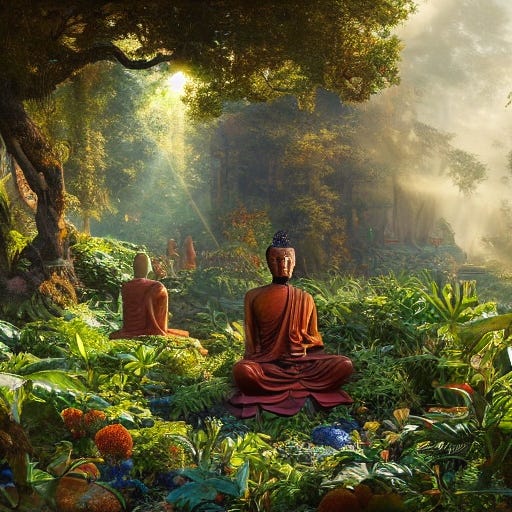
Buddhism, an ancient spiritual tradition originating from the teachings of Siddhartha Gautama, the Buddha, and the Simulation Hypothesis, a modern philosophical concept suggesting that our reality might be a simulated construct, may seem worlds apart at first glance. However, upon closer examination, there are intriguing parallels between these seemingly disparate frameworks. This article delves into the profound connections between Buddhism and the Simulation Hypothesis, exploring how they might complement and enrich each other.
Buddhist Perspectives on Reality
Central to Buddhism is the concept of impermanence (anicca), the idea that all things are in a constant state of flux and change. This aligns with the Simulation Hypothesis, which posits that our reality is dynamic and mutable, akin to lines of code in a vast computer program. The Buddhist view encourages practitioners to recognize the transient nature of existence and detach themselves from the illusions of permanence, echoing the idea that the reality we perceive might be a malleable construct.
Moreover, Buddhism emphasizes the illusory nature of the self (anatta). According to Buddhist teachings, the self is not a fixed, unchanging entity but a collection of impermanent elements. This notion aligns with the Simulation Hypothesis, which suggests that our individual identities and consciousness may be simulated within the overarching framework of a larger reality.
The Illusion of Reality
Buddhism also addresses the illusory nature of reality (maya). The Simulation Hypothesis proposes that our perceived reality is a constructed simulation, mirroring the Buddhist understanding that our conventional understanding of the world is deceptive. In both frameworks, the idea is to look beyond the surface level of existence and question the nature of reality.
The Buddhist concept of samsara, the cycle of birth, death, and rebirth, bears interesting parallels with the Simulation Hypothesis. In the digital realm, iterations and repetitions are integral to the functioning of simulations. Likewise, the notion of samsara underscores the cyclical and repetitive nature of existence, suggesting a potential resonance with the simulated nature of reality.
Mindfulness and Simulation Awareness
Buddhism places a significant emphasis on mindfulness, urging practitioners to cultivate present-moment awareness. This focus on being fully present aligns with the Simulation Hypothesis in a thought-provoking way. If our reality is indeed a simulation, then being present and fully engaged in each moment takes on added significance, as it challenges the illusion of a linear, predetermined timeline.
Simulation theorists argue that increased awareness and introspection might lead to a deeper understanding of the nature of the simulated reality. Similarly, in Buddhism, mindfulness and meditation are seen as tools to pierce through the illusions of existence and gain insights into the true nature of reality.
Ethical Considerations
Buddhism places a strong emphasis on ethical conduct and compassion, promoting the idea of reducing suffering for oneself and others. The Simulation Hypothesis, while primarily a philosophical concept, also opens the door to ethical considerations. If our reality is a simulation, then ethical behavior becomes crucial not only for individual well-being but for the overall functioning of the simulated construct.
While Buddhism and the Simulation Hypothesis emerge from vastly different cultural and temporal contexts, the convergence of their ideas is striking. Both offer profound insights into the nature of reality, urging us to question our assumptions and look beyond the surface of existence. Exploring the symbiosis between Buddhism and the Simulation Hypothesis enriches our understanding of both, providing a fascinating lens through which to contemplate the nature of our perceived reality. Whether through the lens of ancient wisdom or cutting-edge philosophy, the quest for understanding the nature of reality remains a timeless and universal pursuit.