
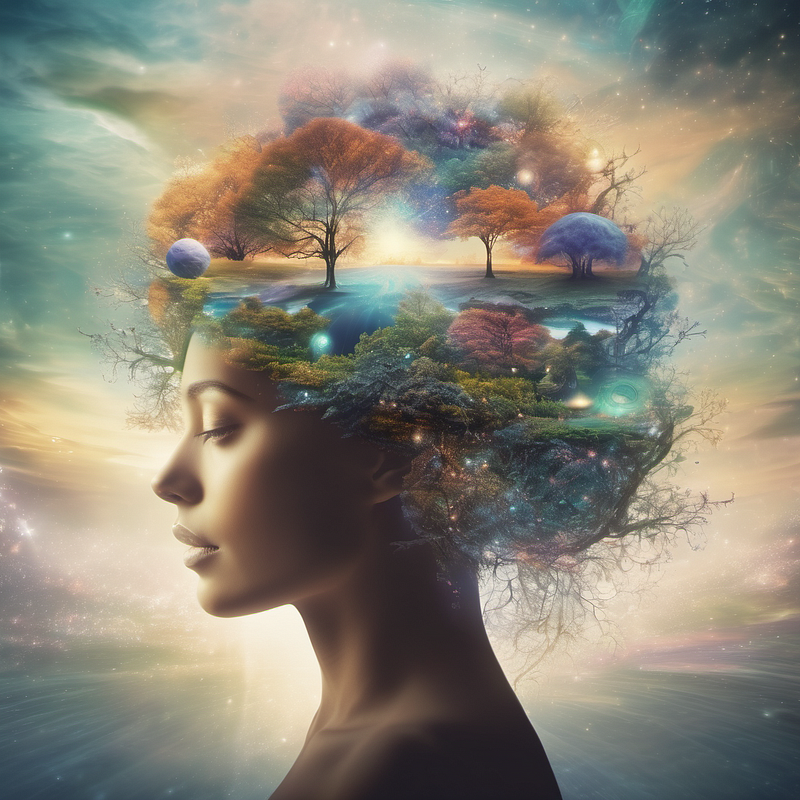
The nature of reality has been a perennial subject of contemplation, with philosophers, scientists, and mystics exploring the intricacies of existence. One captivating perspective posits that consciousness is not merely an emergent property of the physical world but is, in fact, primary to reality itself. In this article, we will delve into the intriguing proposition that consciousness is the foundational fabric from which all of reality unfolds.
The Traditional Materialist View:
Classical materialism suggests that the physical world is the primary reality, and consciousness arises as a product of complex neural processes. This perspective posits that the intricate dance of particles and forces in the universe gave rise to conscious experience. However, the idea that consciousness is primary challenges this materialist paradigm.
Panpsychism: A Middle Ground:
Panpsychism occupies a middle ground between materialism and the view that consciousness is primary. It proposes that consciousness is a fundamental feature of the universe, present even at the level of subatomic particles. In this framework, everything possesses some degree of consciousness, contributing to the overall tapestry of reality.
Consciousness as the Ground of Being:
The proposition that consciousness is primary suggests that it is not an emergent phenomenon but the very ground of being. Advocates of this view argue that consciousness is not generated by the brain; instead, the brain serves as a filtering or tuning mechanism through which consciousness interacts with the physical world.
Quantum Physics and Observer Effect:
Quantum physics, with its enigmatic principles, has been a fertile ground for exploring the relationship between consciousness and reality. The observer effect, which suggests that the act of observation influences the behavior of quantum particles, raises questions about the role of consciousness in shaping the nature of the quantum realm and, by extension, the larger reality.
The Hard Problem of Consciousness:
Philosopher David Chalmers introduced the concept of the “hard problem of consciousness,” highlighting the challenge of explaining why and how physical processes in the brain give rise to subjective experience. If consciousness is primary, the hard problem becomes less problematic, as it reframes the relationship between mind and matter.
Eastern Philosophical Traditions:
Eastern philosophical traditions, such as Advaita Vedanta and certain branches of Buddhism, have long asserted that consciousness is primary. In these traditions, reality is seen as an expression of a transcendent consciousness or awareness that underlies and permeates all phenomena.
Experiential Realities and Subjective Worlds:
The subjective nature of conscious experience suggests that reality is, to a significant extent, shaped by our perceptions and interpretations. If consciousness is primary, the diversity of experiential realities becomes an intrinsic aspect of the larger reality, with each subjective world contributing to the overall richness of the tapestry.
The notion that consciousness is primary challenges conventional views of reality, prompting a reevaluation of our understanding of existence. Whether one aligns with panpsychism, explores the mysteries of quantum physics, or draws inspiration from ancient philosophical traditions, the idea that consciousness is the foundational essence of reality opens up profound avenues for contemplation. As we continue to unravel the enigma of consciousness and its relationship to the world around us, the question of whether consciousness is primary to reality remains an enduring and captivating frontier of inquiry.