
Most people who talk about simulation theory are having the wrong argument. One side insists we’re living inside a cosmic computer, usually with the confidence of someone who just watched a YouTube documentary. The other side rolls their eyes, calls it unfalsifiable philosophy, and moves on. Both camps miss the part that’s actually interesting.
Here’s what I mean. The claim that we are literally running on hardware somewhere, that some advanced civilization booted us up like a game of The Sims with better physics, is a metaphysical claim. You can’t test it. You can’t falsify it. It sits in the same epistemological bucket as solipsism or Last Thursdayism, the idea that the universe was created last Thursday with all our memories pre-loaded. These are fun to think about at 2 a.m. They are not science.
But there’s another version of this idea that people keep tripping over on their way to the metaphysics, and it’s the one worth slowing down for. What if you treat simulation theory not as a truth claim but as a research tool? A lens. A way of generating questions that turn out to have testable answers. If the universe behaves like a computation, what constraints would that impose? What signatures would that leave behind? Those are questions you can actually work with.
The distinction matters because it’s the difference between theology and physics. And when you look at the actual physics, the computational framing keeps turning up results that nobody expected.
The Fine-Tuning Problem Won’t Go Away
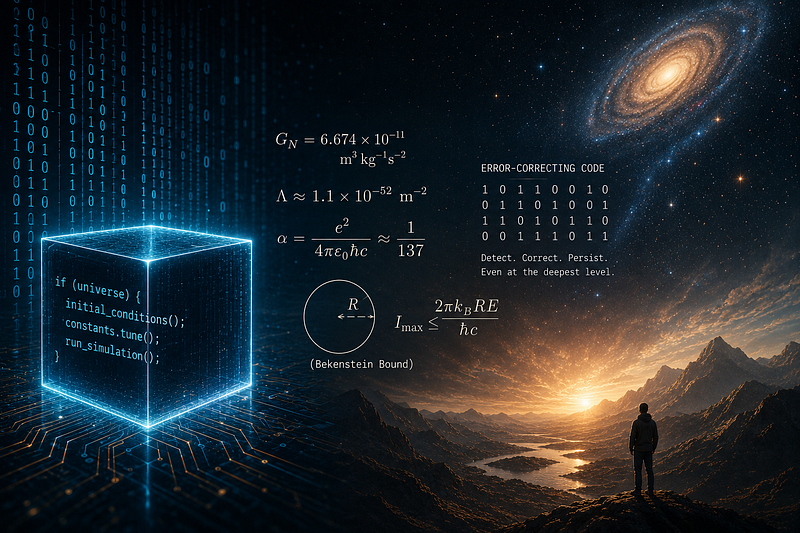
Start with the fine-tuning problem, because everyone does, and because it’s genuinely strange. The physical constants of our universe are calibrated to values that permit complex structure, chemistry, stars, planets, carbon-based life. Adjust the gravitational constant by a tiny fraction and stars never form. Change the strong nuclear force slightly and atoms don’t hold together. The cosmological constant, the one that governs the expansion rate of the universe, is set to a value so improbably small that even physicists who spend their careers working with large numbers have trouble expressing how unlikely it is.
Now, the standard responses to fine-tuning are well-known. The multiverse hypothesis says there are countless universes with different constants, and we just happen to be in one that works. The anthropic principle says we can only observe a universe capable of producing observers, so of course it looks fine-tuned from where we’re standing. These are reasonable responses. They might even be correct.
But notice what the simulation framing does here. It reframes fine-tuning not as a cosmic coincidence or a selection effect but as a design constraint. Parameters chosen to produce specific outcomes. That reframing doesn’t prove anything on its own, but it does suggest a different class of questions. Are the constants independent of each other, or do they exhibit relationships that suggest they were derived from some underlying structure? Are there correlations between seemingly unrelated parameters that would make sense if they shared a common computational origin?
These aren’t idle questions. People are working on them.
Error-Correcting Codes in the Equations of Physics
This is where things get genuinely weird. Sylvester James Gates Jr., a theoretical physicist at the University of Maryland (and not someone prone to sensationalism), was working on supersymmetry equations when he found something he wasn’t looking for. Embedded in the mathematical structure of his equations were what appeared to be doubly-even self-dual linear binary block codes. If that string of words means nothing to you, here’s the short version: these are error-correcting codes. The same kind of codes used in web browsers and computer networks to detect and fix data transmission errors.
Gates found computer code, essentially, sitting inside the equations that describe the fundamental behavior of the universe.
Let me be careful here, because this finding is both less and more than it first appears. Less, because the codes Gates found are embedded in the mathematics of supersymmetry, which is itself a theoretical framework that hasn’t been experimentally confirmed. The codes describe properties of the equations, not necessarily properties of physical reality. More, because the mere existence of these structures raises a question that’s hard to dismiss: why would the mathematics of physics contain patterns identical to computational error-correction? If the universe doesn’t process information, what are the error-correcting codes doing there?
Gates himself has been measured about this. He hasn’t claimed it proves we live in a simulation. What he’s said, and what matters, is that this finding is consistent with a computational substrate underlying physical law. That’s a weaker claim, and a more honest one. It’s also the kind of claim that generates further research rather than ending the conversation.
His work on adinkra symbols, the graphical representations he uses to study supersymmetry, has opened up a small but legitimate research program into the information-theoretic structure of fundamental physics. Whether that program ultimately supports or undermines the computational framing is beside the point right now. The point is that it exists, and it’s producing real mathematics.
The Universe Has a Data Budget
The Bekenstein bound is one of those results in physics that should get more popular attention than it does. Jacob Bekenstein showed that there is a maximum amount of information that can be contained within a given region of space. Not a practical limit, the way your hard drive has a storage cap. A fundamental limit. A physical law.
Think about what that means. If you have a sphere of a certain radius and a certain energy, there is a finite, calculable upper bound on the number of bits of information that sphere can hold. The universe, at the most basic level, has a data budget.
This is strange if you think of the universe as continuous, as analog, as the kind of place where you can always zoom in further and find more detail. It’s exactly what you’d expect if the universe were discrete, if physical reality were, at bottom, computational. A simulation running on finite hardware would necessarily have information limits. Physical reality, according to the Bekenstein bound, has exactly that.
Pair this with the low-entropy initial conditions of the universe, the fact that the Big Bang started in a state of extraordinarily low entropy, a state so improbable that Roger Penrose calculated its likelihood at something like one in ten to the power of ten to the power of 123. That number is so large it’s essentially meaningless as a probability. But it’s not meaningless as a constraint. If you were setting initial conditions for a simulation, you might choose a low-entropy starting state precisely because it produces interesting, complex evolution over time. High-entropy initial conditions produce boring universes. Low-entropy ones produce stars, chemistry, biology, and eventually someone sitting at a keyboard wondering whether it’s all a simulation.
Again, this doesn’t prove the computational hypothesis. But it fits neatly inside it, and that neatness is itself a data point worth tracking.
Quantum Mechanics Acts Like It’s Rendering on Demand
The measurement problem in quantum mechanics is, to put it politely, a mess. Before measurement, a quantum system exists in a superposition of states. When you measure it, the superposition collapses to a definite outcome. What counts as a “measurement”? Why does observation change the behavior of particles? After nearly a century of quantum mechanics, there is still no consensus on what’s actually happening.
The computational framing offers something here that the standard interpretations struggle with: an intuitive analogy that happens to map onto the math. If the universe is computational, the behavior of quantum systems looks a lot like a rendering optimization. Don’t compute a definite state until something needs to interact with it. Keep things in superposition, in a probabilistic distribution, until a measurement forces resolution. This is, almost exactly, how video game engines handle rendering. Don’t draw what the player isn’t looking at.
I want to be careful with this analogy, because analogies are not arguments. The fact that quantum behavior resembles computational rendering doesn’t mean it is computational rendering. Correlation isn’t causation, even when the correlation is spooky. But the analogy has teeth because it does something that most quantum interpretations fail to do: it offers a reason why the universe would work this way. The Copenhagen interpretation describes the measurement problem beautifully and explains it not at all. The many-worlds interpretation explains it by postulating an infinity of unobservable parallel universes. The computational framing explains it by pointing to efficiency. Don’t compute what you don’t need to compute.
Whether that efficiency argument reflects something real about the universe’s structure or just reflects the limits of human metaphor is, I think, one of the more interesting open questions in physics right now.
Consciousness Is Still the Hard Problem, and Nobody Has Cracked It
Then there’s consciousness, and here I’ll admit I’m on shakier ground, because everybody is. The hard problem of consciousness, coined by David Chalmers, asks why subjective experience exists at all. Why does it feel like something to see red, to taste coffee, to be you? Nothing in our physics requires it. You could, in principle, have a universe full of complex information processing with nobody home. And yet, here we are.
The simulation framing doesn’t solve the hard problem. I want to be upfront about that. But it does something interesting: it contextualizes consciousness as a feature rather than an accident. If the universe is a computational system, consciousness might be an emergent property of sufficient information-processing complexity, something the simulation produces when certain conditions are met. Or it might be an intentional component, something built into the system’s architecture.
Neither option is testable right now, and that’s fine. What matters is that the computational framing puts consciousness into a context where it’s a phenomenon to be studied rather than an embarrassment to be explained away. Physicalism struggles with consciousness because physical theories don’t obviously require it. Computational theory doesn’t require it either, strictly speaking, but it’s at least comfortable with the idea that complex systems produce emergent properties that aren’t obvious from the base code.
I’m not going to pretend that’s a strong argument. It’s more of a posture, a willingness to sit with the question without either dismissing it or overclaiming. But posture matters in research. The questions you’re willing to take seriously shape the answers you eventually find.
So Where Does This Leave Us?
Here’s my honest position, for whatever it’s worth. I do think we probably live in a simulation. I hold that belief with open hands, not clenched fists, and I understand why plenty of smart people land on the other side of it. But the evidence, or at least the pattern of evidence, points me in that direction.
What I don’t believe is that this implies a god. I’m an atheist, and the simulation hypothesis hasn’t changed that. I know the parallel is obvious: a creator, a designed universe, an intelligence beyond our comprehension. Religion got there first, and simulation theory does share structural DNA with theism. But there’s a difference between acknowledging that a programmer or an advanced entity might have initialized this system and concluding that such an entity deserves worship, or cares about your dietary restrictions, or has opinions about what you do on Sundays. If there is a simulator, it’s most likely an advanced being operating within its own set of constraints, probably a simulated entity itself, turtles all the way up. That’s a far cry from the omniscient, omnibenevolent deity that organized religion describes. It’s a technician, not a god. And the distinction matters, because conflating the two is how a productive scientific question turns into a faith claim.
What keeps me grounded in that belief, rather than floating off into metaphysics, is the evidence itself. The information limits. The apparent optimization. The error-correcting codes buried in the equations. The suspiciously precise initial conditions. These are real findings from real research programs, not stoned speculation.
The most productive version of this whole line of thinking isn’t “we are definitely in a simulation.” It’s something closer to “the universe exhibits properties consistent with computational structure, and that’s worth investigating regardless of whether it implies a literal simulator.” That version keeps the intellectual substance while shedding the metaphysical baggage that nobody can resolve. You lose the satisfying narrative of a creator and a purpose. But you keep the parts that might actually lead somewhere.
And honestly, that trade-off says something about how good thinking works in general. The satisfying answer and the productive answer are often different things. The guy at the party who insists we’re in the Matrix has a better story than the physicist studying information-theoretic bounds on spatial regions. But the physicist is the one who might actually learn something.
I’d rather be the physicist. Even if I’m just an armchair one.
Like My Work? Want an Easy Way to Support Me?
Hi there! If you’ve enjoyed my work why not click the link below and Buy Me A Coffee? It’s simple and coffee keeps my creative and intellectual juices flowing!
Just click on the image below and it’ll take you to my Buy Me A Coffee page. Thanks so much for reading and supporting me!