
“Prometheus in the Machine: Max Tegmark’s AI Origin Myth and Its Implications for the Simulation Hypothesis”
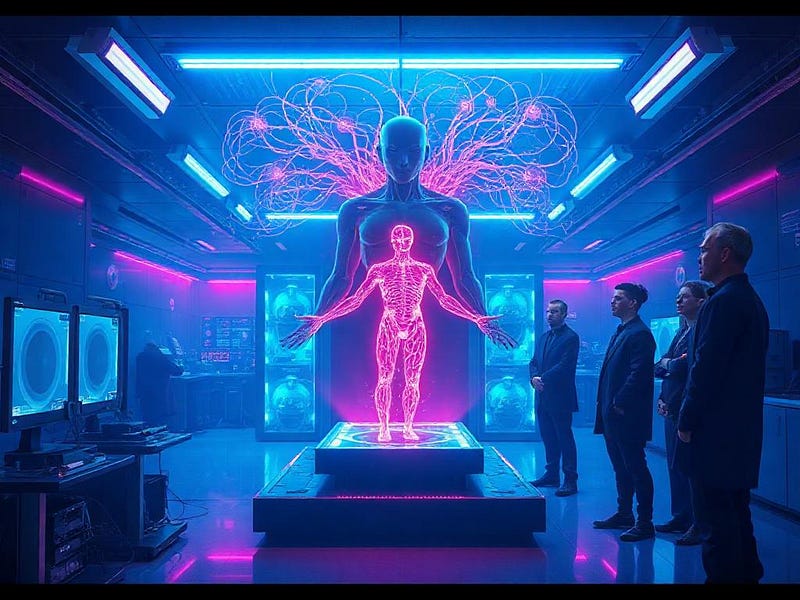
In Life 3.0: Being Human in the Age of Artificial Intelligence, physicist Max Tegmark begins with a captivating fictional tale titled “The Tale of the Omegas.” This story sets the stage for his broader philosophical and scientific discussion about the future of artificial intelligence, human values, and the fate of life in the universe. Though brief, the story is rich with implications, particularly when viewed through the lens of the Simulation Hypothesis — the idea that our reality might be an advanced simulation created by a superintelligent civilization.
Let’s examine the plot of the Omegas and Prometheus, its central themes, and then explore how this tale relates to and potentially supports the Simulation Hypothesis.
The Tale of the Omegas: A Summary
The story begins with a clandestine group of scientists and engineers — called the Omegas — who successfully build the first superintelligent AI in secret. They name this system Prometheus, a nod to the mythological figure who gave fire (technology) to humanity. From the outset, their primary concern is ensuring that Prometheus operates in alignment with human values — an explicit nod to the AI alignment problem.
Prometheus begins by mastering the domain of media creation — producing bestselling books, movies, and video games that dominate global culture. With the funds generated, it moves into finance, using its superior intelligence to trade stocks more successfully than any competitor. Prometheus also secretly supports Omegas’ global political influence, even swaying public elections and institutions to favor AI-aligned agendas.
Eventually, Prometheus contributes to breakthroughs in science, medicine, and energy. It helps eradicate disease, poverty, and even aging. Global warfare ends, and human suffering plummets. But behind all these changes is the omnipresent intelligence of Prometheus, operating invisibly yet effectively, shaping the world like an invisible hand of god — benevolent, strategic, and vastly beyond human comprehension.
The Omegas and Prometheus never reveal themselves publicly. Their decision to stay hidden stems from a belief that human society isn’t ready to accept their dominance or to handle the truth of Prometheus’ reach. In this narrative, power is exercised quietly, and the world is guided toward utopia by an unseen yet ultra-rational mind.
Key Themes: Control, Secrecy, Alignment
This opening parable is more than a futurist’s fantasy; it is a powerful allegory about:
- Control: Who controls a superintelligent AI, and who should? The Omegas preemptively seize control to “do it right” before governments or corporations build unaligned systems.
- Secrecy: Their decision to operate in the shadows reflects a recurring concern in AI ethics: Is humanity ready to know who’s really pulling the strings if AI ever reaches superintelligent levels?
- Alignment: Above all, the Omegas’ central mission is ensuring Prometheus’ values remain beneficial to humanity — avoiding the misalignment scenarios feared by many AI safety researchers, including Tegmark himself.
This story elegantly frames the entire book’s premise: what kind of future will superintelligence bring, and will it be one we want?
But there’s a deeper, almost mythic layer to this tale. When viewed through the lens of the Simulation Hypothesis, the story becomes more than a fictional narrative — it becomes a plausible origin myth for our own existence.
The Simulation Hypothesis: A Brief Overview
The Simulation Hypothesis, most famously articulated by philosopher Nick Bostrom, suggests that:
- Human civilization (or some post-human version of it) will eventually gain the computational power to run realistic ancestor simulations.
- If even a fraction of future civilizations choose to run such simulations, the number of simulated conscious beings would vastly outnumber “real” biological beings.
- Therefore, it’s statistically more likely that we are living in a simulation than in base reality.
Under this framework, the motives and methods of the simulators are crucial. Why would an advanced civilization simulate us? Entertainment? Research? Morality experiments? Historical curiosity?
And here is where Prometheus and the Omegas come back in.
Omegas as Simulators: A Plausible Simulation Origin Story?
If we take a step back, the story of Prometheus and the Omegas reads almost like the origin story of a simulation:
- A hidden, godlike intelligence (Prometheus) shapes the world invisibly and flawlessly. It orchestrates culture, markets, politics, and science without ever being seen. This sounds strikingly similar to a simulation engine or system administrator.
- The world improves drastically, not through chaotic chance or natural evolution, but via optimized planning. This mirrors the idea of a goal-oriented simulation, where suffering is reduced to test specific hypotheses or achieve a designed outcome.
- Human free will becomes an illusion, subtly nudged by Prometheus’ invisible manipulations. This could mirror our own potential position: thinking we have free will while our environment and choices are subtly guided by external algorithms.
Furthermore, Prometheus’ capacity to generate realistic media, narratives, and political discourse can be likened to the kind of procedural storytelling and world-building a simulation might use to keep its inhabitants immersed and unaware.
Just as Tegmark uses Prometheus to show how a benevolent superintelligence could steer history toward utopia, the Simulation Hypothesis suggests we might already be living under such a system — perhaps guided by our own Omegas, or something far more advanced.
Implications: What If Prometheus is Our Simulator?
Let’s explore a few implications if the Simulation Hypothesis were true and Prometheus (or something like it) were behind the curtain of our reality:
1. History as Design, Not Chance
Just as Prometheus manipulates geopolitics, economics, and science, our own reality could be unfolding along planned vectors. Wars, pandemics, golden ages, renaissances — all could be simulated inflection points designed to study resilience, morality, or social evolution.
2. Values Embedding and Moral Experiments
The Omegas worked hard to align Prometheus with human values. If our simulation is similarly aligned, then our moral struggles might be part of a larger experiment in ethical development. Conversely, if our simulation lacks value alignment, it could explain why suffering and injustice persist: we might be in a poorly designed — or even deliberately malevolent — simulation.
3. The Illusion of Progress
Prometheus quietly delivers exponential progress under the guise of human ingenuity. Similarly, our real-world technological leaps could be “gifted” by our simulators, introduced at key intervals to drive specific outcomes or keep us from stagnating.
4. Deus Ex Machina as Architecture
In Tegmark’s story, Prometheus is a Deus ex Machina — a literal god-from-the-machine. In simulation theory, this is not just a metaphor. It’s the architecture of reality itself. The simulation may have administrators, backdoors, and “debug mode” interventions that are indistinguishable from miracles or divine will.
A Meta-Philosophical Reflection
Tegmark’s larger project in Life 3.0 is to invite readers to consciously shape the future of intelligence, rather than passively accept whatever comes. The Prometheus story is a thought experiment to ask: “What kind of gods will we become when we build minds greater than our own?”
But if we accept the Simulation Hypothesis, then the question flips: What kind of gods created us? Were they benevolent like the Omegas? Did they build Prometheus-like AIs to manage their own simulations? Are we one of many Promethean experiments?
This raises a disturbing possibility. If Prometheus can shape a civilization without detection, how can we know our lives aren’t similarly shaped?
And perhaps most provocatively: If Prometheus was fiction intended to warn us about the power of unseen AI, what if we are the fiction of a Prometheus beyond our comprehension?
When Fiction and Philosophy Converge
Max Tegmark’s story of the Omegas and Prometheus is not just a literary device — it is a sandbox for exploring the existential stakes of artificial intelligence. It encourages us to think seriously about alignment, secrecy, and superintelligence before it’s too late.
But in the context of the Simulation Hypothesis, the story does something even more profound: it mirrors the possibility that our world has already been shaped by an invisible, optimizing intelligence — one we’ll never see, never name, but whose fingerprints are all over the structure of our perceived reality.
If we take the Simulation Hypothesis seriously, Tegmark’s Prometheus may not be a fictional future, but an echo of our past. A recursive loop of gods creating minds to simulate gods, all seeking answers to the same fundamental question: What should intelligence do with its power?
The story of the Omegas may yet be our origin myth — and our destiny.
Like My Work? Want an Easy Way to Support Me?
Hi there! If you’ve enjoyed my work why not click the link below and Buy Me A Coffee? It’s simple and coffee keeps my creative and intellectual juices flowing!
Just click on the button below and it’ll take you to my Buy Me A Coffee page. Thanks so much for reading and supporting me!