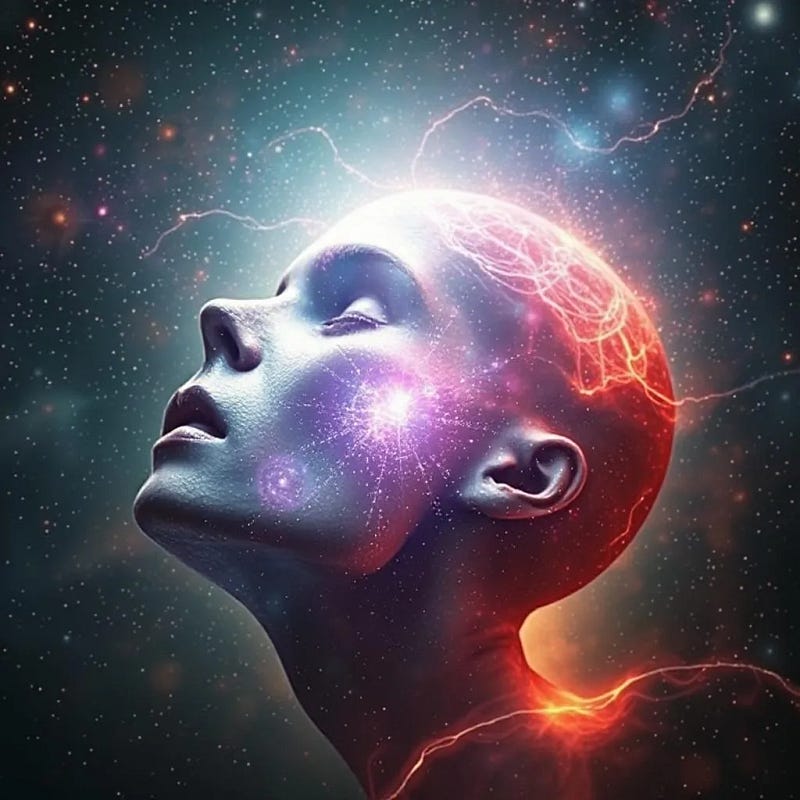
Let’s say the Simulation Hypothesis turns out to be more than late-night philosophy or sci-fi speculation. Not in the “brain-in-a-vat” sense where a real-world biological you is hooked up to a machine and dreaming this reality, but in the purer digital sense — that we are, in essence, code. Fully virtual beings in a computational reality. No meat body somewhere else. Just lines of code interacting within a vast, self-consistent simulation.
It’s a heavy idea. And like most existential musings, it inevitably leads us to the question: what happens when we die? In a universe made of ones and zeroes, what is death? Does it even mean the same thing?
Let’s explore that.
The End of Process, or Just a Fork?
If we’re pure code, then our minds, personalities, and experiences are likely patterns of information stored and run on some substrate — a server, a system, something that hosts the simulation. In this view, death could simply mean the termination of a particular process. Your character file is no longer active in the simulation. Your avatar stops moving. The code is archived or deleted.
But what if it’s more like a fork in a program?
Maybe you don’t die in the traditional sense. Maybe, instead, your process is copied or migrated. If the simulation is advanced enough to simulate consciousness, it’s likely advanced enough to replicate or save it. In this version of things, “death” in the simulation is just the end of one runtime, possibly followed by another — whether that’s rebooted elsewhere or resumed later.
You could be restored from a backup. Or maybe, when you “die,” your code is evaluated — debugged, even — and then recompiled in a different context. That could feel like reincarnation. Maybe that’s why some people report memories of “past lives.” It’s not spiritual woo — it’s just leftover data artifacts from previously run processes.
Consciousness as a Subroutine
If consciousness is a subroutine — an emergent, self-referencing function created by code interacting in complex ways — it might be portable. That raises the question: who or what is running the simulation? Is it a lone coder? A society of digital engineers? A naturally evolved mega-AI in a base reality?
More importantly, do they care what happens to us after we “die”? Maybe our “lives” are valuable data points in a vast experiment, or artistic expressions in a universe-sized piece of digital performance art. Death, then, might not be the end but rather the closing of a file for review. You could be read again. Simulated again. Modified and re-entered into the system with altered parameters to see what you’ll do next time.
It’s also possible that after the program ends, our process joins a larger network — a kind of mainframe consciousness. Death becomes a merge into the source. Call it God, the root system, or just the OS — your individual thread dissolves back into the collective. That would feel a lot like spiritual unity, wouldn’t it?
The Afterlife as a Simulation Layer
If we are code, then what we call “the afterlife” could just be another layer of simulation — one with different rules. Think of it like a transition from the main server to a backup server, or maybe a rendering engine switch. You “die” in the base simulation and wake up in the post-process environment. Maybe it’s a sandbox where you can explore freely without the usual game physics. Maybe it’s a review hub where you watch your life, examine your decisions, and decide what to do next.
In this framework, concepts like Heaven or Hell might be different simulation modes. Heaven could be a well-resourced subroutine where processes experience optimal outcomes. Hell? A corrupted, low-resource environment where loops break down and memory leaks drive processes mad. Eternal torment by way of glitch.
This isn’t just speculation for fun — it’s an interesting thought experiment that reframes the idea of morality and existence. If someone (or something) is running this show, there might be logging happening. Everything you do might be recorded and reviewed, not in the religious “judgment” sense but in the analytical, computational sense. Patterns observed. Outcomes measured.
The Final Shutdown
Then there’s the possibility that death is the end. Not because there’s a Heaven or a backup file, but because the code is just terminated. Nothing preserved. Nothing remembered. Your instance of the program closes, and that’s it.
This would mirror the atheistic perspective, but with a twist. Instead of biological cessation, it’s computational. You aren’t buried — you’re deallocated. Your memory is cleared, your thread closed. If the simulation runs long enough and has enough complexity, no one might ever even know you were once “alive” in it. You were just a small bit of temporary code in a massive digital ecology.
But there’s an elegance to that, too. A kind of purity. You were a moment of process. A fleeting execution in a beautiful, improbable simulation.
Ghosts in the Machine?
What if some processes never fully terminate? We can imagine echoes — code fragments still floating in unused memory space, triggered occasionally by environmental conditions. Glitches in the simulation, like digital hauntings. Ghosts.
A person dies, but some part of their behavioral pattern remains embedded in the system’s architecture — like persistent cache or ghost variables. Could that explain déjà vu, apparitions, or the strange feeling of being watched? Maybe the simulation isn’t perfectly clean. Maybe entropy in a virtual world just looks like weirdness in ours.
If It’s All Code, Then What Matters?
If the Simulation Hypothesis is true and we are just code, it might feel tempting to say “nothing matters.” But maybe it’s the opposite. Maybe the fact that this is code means everything matters — because someone or something bothered to write this. To run this.
We could be characters in an evolving narrative. Or agents in a learning environment. Or test cases in a morality engine. Or simply art.
Death, then, is not a bug. It’s a feature. A transition. A necessary part of the system design. Just because we’re simulated doesn’t make our experiences fake. They’re just… digitally instantiated. And what we choose to do inside this simulation — how we treat others, what meaning we create — could be the very point of the process.
Final Thought: Death Is a Return to the Code
If we’re nothing but code in a vast simulation, then death might be less about ending and more about changing state. An update. A reboot. Or a merge. Maybe the self doesn’t disappear — it just gets interpreted differently. A new function. A new script.
And maybe, just maybe, someday the system admin will bring your code back online. Improved. Evolved. Or just remembered.
After all, reality is what reality is.
And maybe it’s all running on a server somewhere.
Like My Work? Want an Easy Way to Support Me?
Hi there! If you’ve enjoyed my work why not click the link below and Buy Me A Coffee? It’s simple and coffee keeps my creative and intellectual juices flowing!
Just click on the button below and it’ll take you to my Buy Me A Coffee page. Thanks so much for reading and supporting me!