
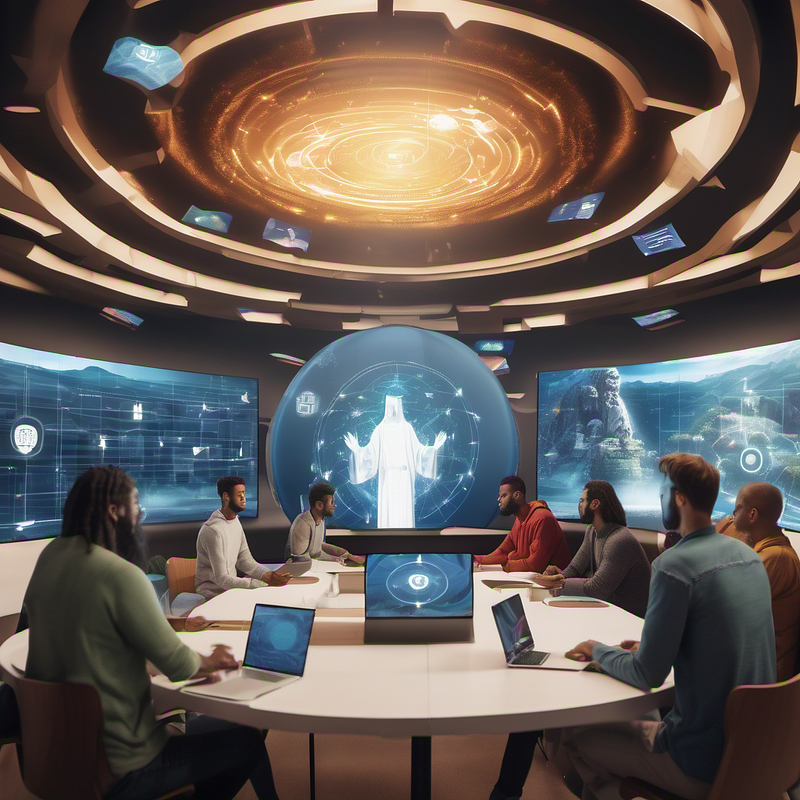
Countering Christian claims against the simulation hypothesis involves understanding the nuances of both the theological perspectives and the scientific and philosophical arguments behind the hypothesis. Here’s a detailed breakdown of how one might approach this:
Introduction
The simulation hypothesis posits that reality, or a significant part of it, could be an artificial simulation, such as a computer-generated environment. First proposed in a more modern context by philosopher Nick Bostrom, it raises questions about existence, consciousness, and the nature of the universe. Some Christians object to this hypothesis on theological and philosophical grounds, arguing it conflicts with doctrines about creation, divine providence, and human dignity.
Understanding Christian Objections
- Creation and Divine Sovereignty: Many Christians believe that God created the universe and everything in it, including each human being, with purpose and intentionality. The simulation hypothesis seems to undermine this by introducing the possibility of other creators (simulators), thus challenging the uniqueness and sovereignty of God.
- Human Dignity and Free Will: Christian doctrine often emphasizes the inherent dignity of human beings created in the image of God, along with the genuine freedom of the will. If our reality is simulated, this could imply that humans are merely sophisticated programs, which could undermine beliefs about free will and moral responsibility.
- Existence of the Soul: Many Christians hold that humans possess an immaterial soul that survives after death. The simulation hypothesis, focusing on physicalism and materialism, appears to discount non-physical entities like souls.
Philosophical Counterarguments
- Ontological Status of God and Simulators: One could argue that even if we are in a simulation, it does not necessarily negate the existence or sovereignty of God. God could be the creator of the simulators, thereby maintaining divine sovereignty over all that exists, both simulated and non-simulated.
- Compatibilism in Free Will: Philosophers like Daniel Dennett argue for compatibilism, which suggests that free will can be compatible with determinism. If our actions are determined by the simulation’s code, one might still argue for a type of moral responsibility and agency, similar to compatibilism in a deterministic world.
- Simulation as Creation: The hypothesis could be re-framed not as a contradiction to Christian creation, but as an extension of it. If God created humans with the capability to simulate realities, then such activities could be seen as a continuation of divine creative action, not its denial.
Scientific Perspectives
- Lack of Empirical Evidence: As of now, there is no direct empirical evidence supporting the simulation hypothesis. This allows for both religious and secular individuals to skeptically view the hypothesis as an interesting philosophical thought experiment rather than a plausible factual claim.
- Limits of Technology: Current scientific understanding and technological capabilities are far from creating consciousness or a universe-sized simulation. This gap highlights the speculative nature of the hypothesis and supports a cautious interpretation of its implications.
Theological Reflections
- God’s Transcendence: Even if our reality were a simulation, Christian theology might view God as transcendent beyond all layers of simulation — ultimate reality beyond all contingent realities.
- Eschatological Hope: Christian eschatology, which deals with the end times and the fate of souls, provides a framework that transcends physical realities, simulated or not. The promise of resurrection and eternal life could be seen as unaffected by our possibly simulated condition.
Conclusion
In countering Christian claims against the simulation hypothesis, the goal isn’t to prove the hypothesis true, but rather to demonstrate that its implications can be compatible with Christian thought. By exploring these intersections, both believers and non-believers can engage in a meaningful dialogue about the nature of reality, the limits of human understanding, and the mysteries of divine creation. This approach respects both the richness of Christian theology and the intriguing possibilities posed by modern philosophical and scientific ideas.
Like My Work? Want an Easy Way to Support Me?
Hi there! If you’ve enjoyed my work why not click the link below and Buy Me A Coffee? It’s simple and coffee keeps my creative and intellectual juices flowing!
Just click on the button below and it’ll take you to my Buy Me A Coffee page. Thanks so much for reading and supporting me!