
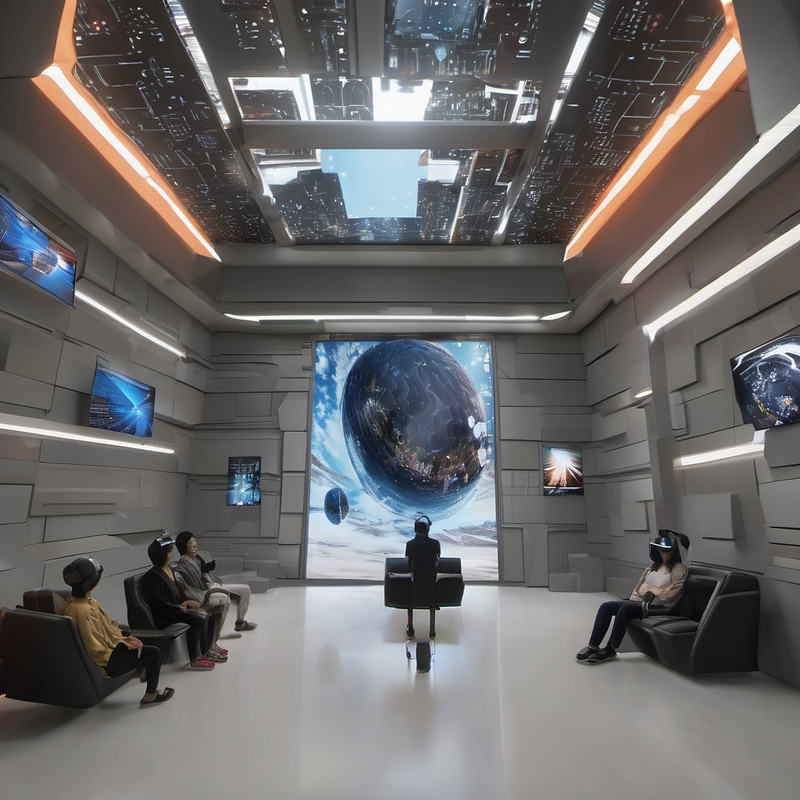
The realms of Artificial Intelligence (AI) and Simulation Theory stand at the forefront of contemporary discourse, each challenging our understanding of reality and consciousness. This article delves into the intriguing intersection of AI and Simulation Theory, examining how advancements in artificial intelligence not only draw inspiration from the concept of simulated realities but also contribute to the discourse surrounding the nature of our own existence.
AI as Simulation Creators:
In the context of Simulation Theory, the idea posits that our reality is a product of a highly advanced simulation crafted by an external intelligence. Artificial Intelligence, in its quest for autonomy and self-improvement, echoes the role of a simulated reality creator. AI systems, with the ability to learn, adapt, and evolve, mirror the hypothetical creators of a simulated universe.
Mimicking Consciousness:
As AI systems become increasingly sophisticated, there is a growing interest in replicating aspects of human consciousness. The pursuit of artificial general intelligence (AGI) aims to create machines that can not only perform specific tasks but also exhibit a form of general intelligence comparable to human cognition. This endeavor raises questions about the potential of AI to simulate conscious experiences, paralleling the simulated reality hypothesis.
Virtual Environments and Reality Simulation:
AI plays a pivotal role in creating virtual environments and simulations for various applications, from video games to training scenarios. The more advanced these simulations become, the closer they approach the complexity of the world we perceive. This convergence prompts reflection on the parallels between AI-generated virtual realities and the concept of our own reality as a simulation.
Algorithmic Realities and Deterministic Systems:
Simulation Theory suggests that our reality follows predetermined rules and operates within a deterministic system. Similarly, AI relies on algorithms and deterministic processes to make decisions and perform tasks. The exploration of algorithmic realities within AI research aligns with the idea that our own reality could be subject to a set of programmed rules.
Quantum Computing and Simulation Hypothesis:
Quantum computing, a burgeoning field within AI, has the potential to revolutionize computational power. In the context of Simulation Theory, the capabilities of quantum computers raise intriguing questions about their role in simulating complex realities. The intersection of AI and quantum computing deepens the exploration of the simulation hypothesis.
AI Ethics and the Moral Landscape of Simulated Realities:
The development of ethical frameworks for AI involves grappling with questions of morality, responsibility, and the potential consequences of creating intelligent, autonomous entities. Similarly, Simulation Theory invites contemplation of the moral landscape within a simulated reality — how the creators would dictate ethical principles for the entities within their simulated construct.
The Observer Effect and Conscious AI:
The observer effect, a concept in quantum mechanics, suggests that observation influences the behavior of particles. In AI, the development of conscious machines prompts considerations about the observer effect within artificial consciousness. This parallel raises questions about the role of consciousness in shaping reality, whether simulated or artificial.
The entanglement of AI and Simulation Theory forms a tapestry of exploration at the intersection of technology, philosophy, and the nature of existence. As AI systems evolve, their capabilities and implications resonate with the speculative notions proposed by Simulation Theory. The convergence of these fields challenges us to consider the profound implications of both artificial intelligence and the potential simulated nature of our own reality. In this dynamic interplay, the boundaries between creator and creation, observer and observed, blur, inviting us to contemplate the nature of consciousness, reality, and the profound questions that lie at the forefront of our collective inquiry.