
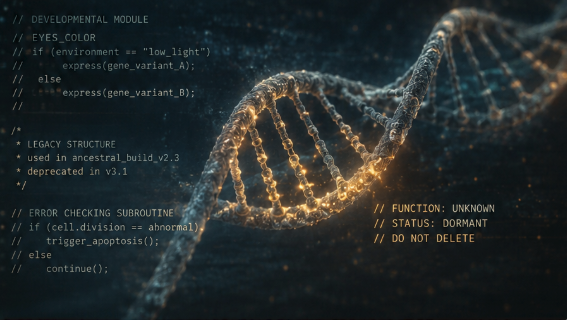
What If “Junk DNA” Is Commented-Out Code?
The human genome may have more in common with an old software system than a clean set of instructions.
Anyone who has worked with an old codebase knows what it looks like.
There are functions nobody remembers writing. Sections have been disabled rather than deleted. Old compatibility fixes remain because removing them might break something unexpected. A module marked “deprecated” still handles one obscure process on alternate Tuesdays.
Then there are the comments:
// Do not remove.
// Needed for legacy support.
// Original purpose unknown.
The human genome sometimes looks like that kind of system.
Only about two percent of our DNA directly codes for proteins. The rest is usually described as non-coding DNA, although the older term “junk DNA” still turns up in popular conversation. Scientists now know that some non-coding regions regulate gene activity, produce working RNA molecules, or perform structural jobs. Other regions still have no known purpose.
That leaves us with an interesting thought experiment.
What if some of this material resembles commented-out code?
A genome is not a clean program
We tend to picture DNA as an instruction manual. Find the right page, read the gene, build the protein.
That picture is useful, but it is much too tidy.
A genome is less like a manual written from beginning to end and more like a system that has been copied, altered, patched, invaded, repaired, and passed down for billions of years. New material gets added. Old material breaks. Fragments are reused for jobs that did not exist when the sequence first appeared.
Nothing begins again with a blank file.
Evolution works with whatever survived the previous version.
Pseudogenes look like disabled functions
The human genome contains more than 14,000 known pseudogenes. These are sequences that resemble working genes but have accumulated mutations that prevent them from producing the original protein. They are often described as evolutionary relics.
In software terms, a pseudogene might resemble an old function that no longer compiles.
The main program has moved on, but the earlier version remains in the repository. Perhaps it once worked. Perhaps it was copied during an update and then abandoned. Perhaps another part of the system now handles the same job.
Some pseudogenes appear to be genuinely inactive. Others can still produce RNA or affect the behavior of working genes. In one large CRISPR-based study, researchers identified roughly 70 pseudogenes that affected the fitness of a particular type of breast-cancer cell. That does not mean every pseudogene has a hidden purpose. It means “broken copy” and “useless sequence” are not always the same thing.
Old code can stop doing its original job and still influence the system around it.
Transposable elements are self-copying code
A much larger part of our genome comes from transposable elements. These are DNA sequences that can copy or move themselves into new locations.
They account for roughly 45 percent of the human genome. Many are no longer mobile, and a large number may now be neutral passengers. Others have been adapted by evolution for regulatory work.
The software comparison becomes stranger here.
Imagine a piece of code that inserts copies of itself throughout a program. Most copies do nothing useful. Some disrupt working functions. A few land in places where they accidentally improve the system.
Given enough generations, those useful accidents may become permanent features.
Researchers have found that transposable elements contribute a sizable share of the human genome’s candidate regulatory elements. One 2024 study estimated that about a quarter of these regulatory regions were derived from transposable elements.
What began as self-serving genetic material can end up helping control when nearby genes operate.
That is less like a programmer designing a feature and more like a maintenance team discovering that an old bug has become part of the architecture.
Some of our code came from viruses
About eight percent of the human genome consists of sequences derived from ancient retroviruses. These viruses once inserted genetic material into the reproductive cells of our ancestors. The viral DNA then became hereditary and traveled forward through generations.
Most of those viral remains can no longer produce a functioning virus.
Yet evolution has reused parts of them.
Some viral sequences now participate in gene regulation and development. They are fragments of outside code that entered the system, lost their original independence, and were eventually put to work by the host.
Software developers might call that a third-party dependency.
Biologists call it evolution.
Dormant does not mean useless
The “commented-out code” idea becomes especially tempting when we consider gene regulation.
Nearly every cell in your body contains essentially the same genome, yet a liver cell behaves differently from a neuron. The difference lies largely in which instructions are active, how strongly they are read, and when that activity occurs. Gene expression works through layers of switches, controls, chemical markers, and physical packaging.
A sequence may appear inactive in an adult skin cell while being important during early development. It may operate only during illness, stress, or tissue repair. It may remain silenced because activating it would cause trouble.
That sounds less like code erased with comment marks and more like a feature hidden behind permissions.
The instructions remain present. Access is restricted.
Where the comparison breaks down
This metaphor is useful, but it can also mislead us.
Commented-out software was usually disabled by someone. DNA does not provide evidence that an outside programmer sat down and wrote the human genome. Mutation, natural selection, genetic drift, duplication, viral insertion, and ordinary inheritance can produce systems that resemble old software without requiring an engineer.
There is also a difference between activity and purpose.
A stretch of DNA may bind a protein or be copied into RNA without benefiting the organism. Biological systems are noisy. Selfish genetic elements can be active because that activity helps them reproduce, even when it does nothing for us. Researchers continue to debate how “function” should be defined, and biochemical activity alone is not enough to settle the question.
Some non-coding DNA performs important work.
Some may be raw material for future evolution.
Some may simply be debris that the genome has never had enough reason to remove.
All three can be true.
Legacy code does not require a programmer
The most interesting part of the analogy may have little to do with intelligent design.
Legacy code tells a story.
It shows which problems once existed, which solutions survived, which failures were copied forward, and which forgotten pieces later found another use. The human genome does the same. It contains the remains of ancient infections, broken genes, duplicated instructions, mobile elements, and regulatory machinery assembled from older parts.
Calling all of it “junk” is too dismissive.
Calling all of it purposeful goes too far in the other direction.
The genome appears to be a mixture of working systems, disabled machinery, opportunistic reuse, selfish passengers, and historical clutter. It is messy because life did not begin with a plan for a modern human being. Each generation inherited an existing system and made small changes to it.
We are running code that has never been fully rewritten.
No one knows what every line does.
And removing the wrong one may reveal why it was still there.
Like My Work? Want an Easy Way to Support Me?
Hi there! If you’ve enjoyed my work why not click the link below and Buy Me A Coffee? It’s simple and coffee keeps my creative and intellectual juices flowing!
Just click on the image below and it’ll take you to my Buy Me A Coffee page. Thanks so much for reading and supporting me!