
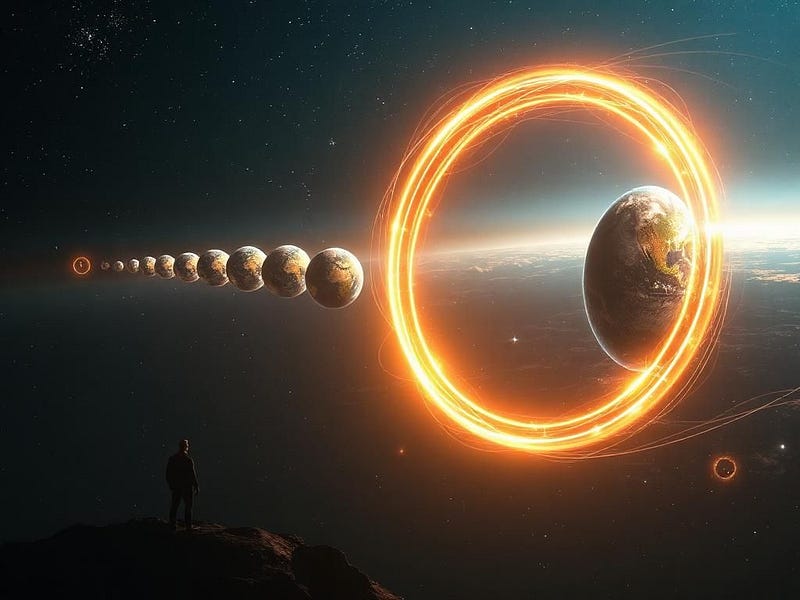
If you’ve ever had déjà vu, you know the weird feeling it gives you. It’s that moment when you swear you’ve been in this exact spot, seen this exact thing, or heard these exact words before. Most of the time we brush it off as a brain glitch, the neurons firing in some strange way that makes us think we’re reliving a moment.
But what if it’s not just a glitch? What if déjà vu is a clue? What if it’s a hint that we’ve been here before, not just in our own lives, but in the grand, cosmic sense?
Some thinkers and storytellers have tossed around an idea that our reality might be more like a program running on a loop than a straight line from start to finish. Instead of one big bang leading to one final end, we could be in a simulation that resets itself. When it’s over, it starts again, maybe with a few tweaks. And just like in a video game, some of the “data” from the last run might leak into the next.
Time as a Circle, Not a Line
The idea of time being cyclical isn’t new. Ancient cultures, from the Hindus with their concept of yugas, to the Stoics and their eternal return, have talked about existence moving in endless loops. In those stories, the world ends and is reborn over and over. The names and details change, but the rhythm is always the same.
Now, if you overlay that old idea onto the modern Simulation Hypothesis, you get something interesting. Imagine a simulation that runs through a certain stretch of history, collects whatever data it’s looking for, and then resets back to the start. Maybe it’s done to refine outcomes, or maybe it’s done just to keep the system from crashing. Either way, we’d be living inside a repeating cycle without even knowing it.
And here’s the kicker: if that’s true, it wouldn’t feel like a loop to us. The reset would wipe our memories clean. We’d think we were living life for the first time. But maybe, deep down, something lingers. Maybe that’s where the odd flashes of familiarity come from.
The Reset Button
If you’ve played a video game, you know about restarting. You mess something up, or the path you’ve taken isn’t giving you what you want, so you hit “restart.” All the progress you made is gone, but you remember the layout of the map, where the enemies spawn, or where the treasures are hidden. On the next run, you do better because you’ve learned from the first try.
Now, picture our universe as a game like that. Whoever is running it might have a reason to restart it over and over. Maybe they want to see how civilizations evolve under different conditions. Maybe they’re testing how morality plays out if a few key events are altered. Or maybe the whole point is just to watch endless variations of life unfold.
If there’s a reset button, then every “version” of the universe might be slightly different. Maybe in one cycle, a certain empire never falls. In another, a disease wipes out a third of the population earlier than in the previous run. And in another, someone invents faster-than-light travel before we discover the internet.
The possibilities are endless, and if we’re in one of these loops, we’d never really know… unless the system isn’t perfect.
Echoes from Past Runs
Here’s where déjà vu and intuition come in. What if those strange feelings are fragments of memory from a past cycle leaking into the current one? Maybe you meet someone for the first time but instantly feel like you’ve known them for years. Or you get an unshakable sense that you shouldn’t go down a certain road, even though you’ve never been there before.
In a purely biological explanation, those feelings are chalked up to pattern recognition or subconscious processing. But in the reset-loop theory, they could be like ghost data — scraps of experience from a previous version of reality that didn’t quite get deleted.
Dreams might also be part of this. Some dreams feel random and absurd, but others feel loaded with meaning. Maybe that’s because they’re pulling from an archive your brain doesn’t know it has. A place where old runs of the simulation are still stored.
Are We the Ones Doing the Resetting?
Here’s a twist to consider: what if the simulation isn’t being run by some alien intelligence or god-like programmer, but by us? Not us as we are now, but by our far-future descendants who’ve reached a point where they can simulate entire universes.
In that case, the reset button might be part of an experiment we’ve set up for ourselves. We could be testing the same “level” over and over to see which choices lead to the best outcomes. Maybe the goal is to reach some sort of ideal civilization, and every time we fail, we start again.
If that’s the case, then we’re not just NPCs in someone else’s game. We’re the players and the played. We’re the ones who set the rules, but we’re also the ones living under them without remembering why.
Why It Matters
At first, you might think it doesn’t matter if we’re in a loop. If we don’t remember the last run, who cares? We just live this life like it’s the only one. But if you look closer, the loop theory has some interesting implications.
For one, it changes how we see consequences. If the simulation resets, it might seem like nothing we do matters in the long run. But maybe it matters more than ever. What if the “save data” from each cycle is used to shape the next one? What if the way we treat each other now determines the starting conditions for the next version of the world?
It also changes how we think about progress. If civilizations keep rising and falling in a loop, then the story of humanity isn’t a straight climb toward some final goal. It’s a spiral. We keep coming back to the same kinds of challenges, just at different points along the curve.
Living Like It’s the First and Last Time
Whether or not the reset-loop theory is true, there’s something freeing about thinking this might be one run in a long series. It makes you want to make the most of it. If we’ve been here before and will be here again, then maybe the point isn’t to “win” but to play the game as well as we can this time around.
If déjà vu is an echo, then maybe it’s not just a glitch. Maybe it’s a little tap on the shoulder from your past self, saying, “Pay attention. This matters.”
And if we are living in a repeating cycle, then the real question isn’t whether we can break out of it. It’s whether we can make each loop worth living, no matter how many times the clock resets.
Because until someone shows us the code, this is the only version of reality we know. And if we’re lucky, it’s a good one.
Like My Work? Want an Easy Way to Support Me?
Hi there! If you’ve enjoyed my work why not click the link below and Buy Me A Coffee? It’s simple and coffee keeps my creative and intellectual juices flowing!
Just click on the image below and it’ll take you to my Buy Me A Coffee page. Thanks so much for reading and supporting me!