
The Simulation Hypothesis and the Nature of Reality: A Computational Explanation for Quantum Mysteries
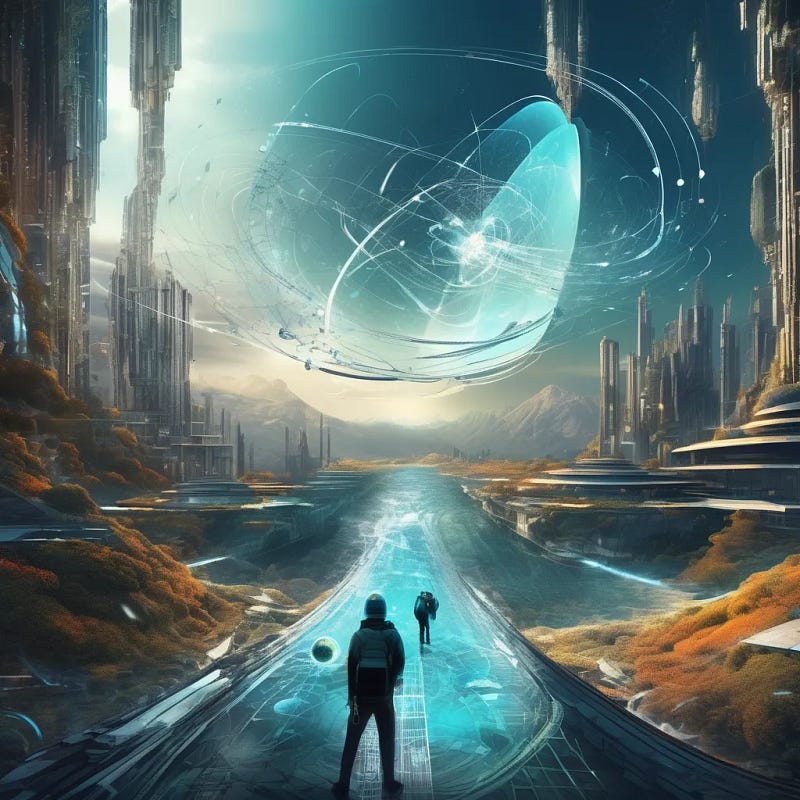
The Simulation Hypothesis posits that our reality is not a fundamental physical construct but a computed, stored, and processed phenomenon similar to a sophisticated virtual environment. This perspective offers compelling answers to some of quantum mechanics’ most perplexing mysteries, including the observer effect, the collapse of the probability wave, and the potential existence of parallel universes. By considering reality as a computationally rendered experience, we can unify these seemingly disparate phenomena under a single, coherent framework.
Reality as Computation: The Foundation of the Simulation Hypothesis
The Simulation Hypothesis suggests that the universe operates similarly to a digital simulation, where physical reality is generated dynamically rather than existing as an immutable structure. In this model, space, time, and matter are processed and rendered as needed, akin to how modern video games only load what is immediately observable by the player. This concept allows us to approach fundamental quantum mechanical paradoxes from a novel perspective.
The Observer Effect: Information Processing and Reality Rendering
One of the most famous conundrums in quantum mechanics is the observer effect, which suggests that the mere act of observation alters the outcome of an experiment. This phenomenon is most famously demonstrated in the double-slit experiment, where particles behave as waves when unobserved but appear as particles when measured.
Under the Simulation Hypothesis, this behavior can be understood in terms of computational efficiency. Just as video game environments do not render objects unless they are within the player’s field of vision, a simulated reality would optimize processing power by only resolving quantum states into definite properties when they need to be observed. This mechanism suggests that particles do not possess fixed attributes until measurement forces the system to render them explicitly.
In this context, observation is not merely a passive act but an information request within the system. Before measurement, a particle exists in a superposition — a probability cloud of possible states. When an observer interacts with it, the system retrieves the necessary information and renders a specific state, collapsing the probability wave into an observable form.
Wave Function Collapse: A Simulation’s Optimization Strategy
The concept of wave function collapse, where a quantum system transitions from multiple potential states to a single definite outcome, aligns well with computational processes. In video games and simulations, multiple potential actions and pathways exist until the player’s choice determines a single rendered outcome. Similarly, reality, under the Simulation Hypothesis, operates as a probability field that resolves into concrete existence only when computational resources are directed toward processing an event.
This approach answers the philosophical challenge of why unmeasured quantum systems remain in a probabilistic state. In a simulated universe, maintaining all potential states simultaneously would require immense computational power. Instead, a simulation economizes by only rendering reality when necessary — collapsing possibilities into singular events upon interaction. This model eliminates the need for a mysterious, non-deterministic quantum interpretation and instead frames wave function collapse as an intrinsic part of an optimized computational reality.
Parallel Universes: The Many Simulated Possibilities
Quantum mechanics and the Many Worlds Interpretation suggest that all possible outcomes of a quantum event may exist simultaneously in parallel universes. The Simulation Hypothesis provides an alternative yet compatible view of this theory by framing these alternate realities as computational branches within the system.
In a simulated universe, each potential quantum event could be stored as a branching data structure — similar to how video games save multiple states of a game for different possible player choices. When an observation collapses a probability wave, the simulation could either discard unselected possibilities or store them in an alternate computation thread, effectively generating parallel simulated realities.
From this perspective, parallel universes exist not as infinite physical dimensions but as alternate renderings of computationally stored outcomes. This mechanism suggests that our reality, as we perceive it, is merely the most immediate and actively computed timeline among many possible branches.
Implications for Free Will and Consciousness
If reality operates as a simulation, then consciousness itself may function as an interface interacting with the computational substrate. This raises significant questions about free will — if all possible choices exist as potential branches, is our experience of decision-making merely a function of our rendered timeline? Alternatively, does consciousness influence which branches of the simulation are selected and rendered?
Some interpretations of the Simulation Hypothesis suggest that consciousness acts as an agent directing computational attention. If observation collapses probability waves, it implies a participatory role of awareness in shaping reality. This concept resonates with theories suggesting that human consciousness has a direct impact on the material world, lending further credence to the idea that reality is not a fixed structure but an interactive, dynamically generated experience.
Challenges to the Simulation Hypothesis
While the Simulation Hypothesis provides a coherent framework for understanding quantum phenomena, it also raises fundamental challenges. One primary question is: Who or what runs the simulation? If reality is computed, there must exist a higher-order intelligence or system that manages it. This invokes metaphysical considerations about the nature of the “simulators” — whether they are advanced extraterrestrial entities, future human civilizations, or even a self-perpetuating computational system.
Additionally, if reality is a simulation, it must be capable of error detection and correction. Some researchers have hypothesized that cosmic anomalies, unexplained quantum fluctuations, or inconsistencies in fundamental physical constants could serve as evidence of computational artifacts — glitches within the simulated environment.
A New Paradigm for Understanding Reality
The Simulation Hypothesis offers a revolutionary way to interpret reality by aligning quantum mechanics with principles of computation. It provides intuitive explanations for the observer effect, wave function collapse, and parallel universes, framing them as natural consequences of an optimized processing system.
If reality is indeed a simulation, it suggests that our universe is not a fundamental construct but an emergent experience shaped by observation, computation, and interaction. This perspective challenges classical materialist assumptions and opens new frontiers for exploring the nature of existence, consciousness, and the ultimate question: What exists beyond the simulation?
While the hypothesis remains speculative, its explanatory power in addressing quantum paradoxes and fundamental mysteries of existence makes it an intriguing framework — one that may redefine our understanding of the universe in the decades to come.
Like My Work? Want an Easy Way to Support Me?
Hi there! If you’ve enjoyed my work why not click the link below and Buy Me A Coffee? It’s simple and coffee keeps my creative and intellectual juices flowing!
Just click on the button below and it’ll take you to my Buy Me A Coffee page. Thanks so much for reading and supporting me!