
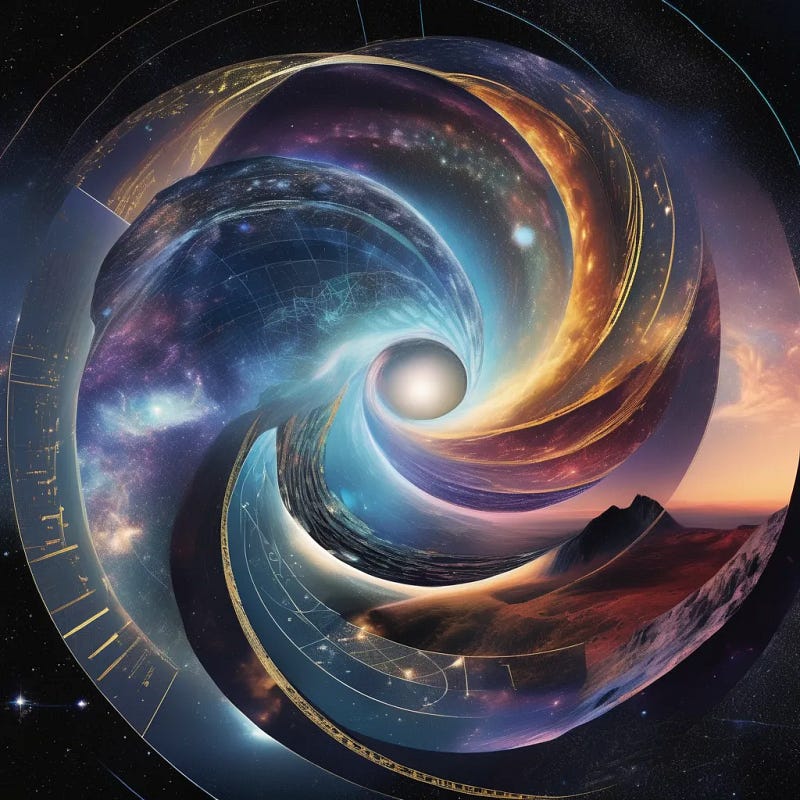
In recent years, the boundaries between physics, cosmology, and philosophy have increasingly blurred, particularly as scientists and thinkers grapple with the ultimate nature of reality. Two intriguing ideas that have emerged from this confluence are the Simulation Hypothesis and the Conformal Cosmic Cosmology Model (CCCM). Although these concepts originate from different intellectual traditions — one from speculative philosophy and the other from theoretical physics — they both challenge conventional notions of the universe and our place within it. Exploring the intersection of these ideas can provide new insights into the nature of reality and the potential for our universe to be part of something even grander than previously imagined.
The Simulation Hypothesis: A Brief Overview
The Simulation Hypothesis, most famously articulated by philosopher Nick Bostrom, posits that our reality could be an artificial simulation, possibly created by an advanced civilization. According to this hypothesis, if it is possible to create a highly realistic simulation of a universe, and if future civilizations have both the technology and the motivation to do so, then it is statistically probable that we are living in one of these simulations rather than in a “base” reality.
This idea challenges our understanding of existence, suggesting that what we perceive as real might be akin to a complex computer program, with physical laws and constants being part of the simulation’s code. The hypothesis also raises profound questions about consciousness, free will, and the nature of the beings (or entities) that might have created our simulated universe.
Conformal Cosmic Cosmology Model: An Overview
The Conformal Cosmic Cosmology Model, championed by the mathematician and physicist Sir Roger Penrose, offers a radical rethinking of the universe’s structure and evolution. Penrose’s CCCM is a cyclical model that suggests the universe goes through infinite cycles of birth, expansion, and eventual death, followed by rebirth. According to this model, the universe’s end is not a final state but rather the beginning of a new phase, where the infinite future of one “aeon” (a complete cycle of the universe) becomes the infinite past of the next.
A key feature of the CCCM is the idea of “conformal” symmetry, which suggests that the universe’s geometry remains consistent between the end of one aeon and the start of another. This model proposes that the extreme conditions at the end of the universe, when it becomes cold and empty, are conformally equivalent to the very hot and dense conditions at the universe’s beginning, allowing for a seamless transition between cycles.
Intersection of the Two Concepts: A Theoretical Synthesis
The Simulation Hypothesis and the Conformal Cosmic Cosmology Model might seem unrelated at first glance, yet there are several intriguing points of intersection between them:
1. Cyclical Universes and Simulated Resets
- Cyclical Nature: Both the CCCM and some interpretations of the Simulation Hypothesis suggest a cyclical nature to the universe. In the CCCM, the universe undergoes infinite cycles of birth and death, with each new cycle (aeon) emerging from the previous one. In a simulated reality, one could imagine the possibility of the simulation being “reset” or rebooted at various points, either by its creators or as part of the simulation’s inherent design. Each new cycle in the simulation could mirror the cyclical nature of the universe in the CCCM, potentially with slight variations in the “code” or parameters that lead to different outcomes in each iteration.
- Resets as New Aeons: If our universe is a simulation, the end of one simulation and the beginning of another could be seen as analogous to the transition between aeons in the CCCM. The idea that the universe might be re-simulated with new conditions or rules could parallel the conformal symmetry that allows for the seamless transition between aeons in Penrose’s model.
2. Simulation as a Tool for Understanding Conformal Geometry
- Conformal Symmetry: Penrose’s CCCM relies on the concept of conformal symmetry, where the shape and structure of the universe are preserved across different scales and phases of its evolution. This notion could be simulated in a computational framework, allowing researchers to test and explore the mathematical consistency of such a model. The Simulation Hypothesis offers a conceptual tool for imagining how such complex geometrical relationships might be encoded and manipulated within a simulated reality.
- Modeling Cosmological Phenomena: If our universe is a simulation, the underlying “code” could be designed to explore various cosmological models, including the CCCM. The creators of the simulation might be interested in testing different theories of the universe’s structure and evolution, using the simulation as a vast laboratory for cosmological experimentation. This could mean that the CCCM is one possible scenario among many being explored within the simulation.
3. Implications for the Nature of Reality
- Reality as a Simulation: The CCCM suggests a universe that is far more complex and cyclical than the traditional Big Bang model, while the Simulation Hypothesis proposes that our reality might not be fundamental but rather a constructed simulation. If these ideas intersect, it could imply that the cycles of the universe described in the CCCM are not merely natural phenomena but are programmed into the simulation’s design. The implications of this are profound, as it raises the possibility that the cyclical nature of the universe is a deliberate feature of the simulation, possibly serving a purpose we cannot fully understand.
- Multiverse and Multiple Simulations: Penrose’s CCCM implies that multiple aeons exist, each with its own distinct characteristics. Similarly, the Simulation Hypothesis allows for the possibility of multiple simulated realities, each with different physical laws or configurations. The intersection of these ideas could suggest that each aeon in the CCCM is a different “instance” of the simulation, with each cycle representing a new attempt by the simulators to explore different aspects of cosmic evolution.
Conclusion: A New Lens on Reality
The intersection of the Simulation Hypothesis and the Conformal Cosmic Cosmology Model offers a novel way to think about the nature of our universe and the possibilities of its origins. While one concept emerges from speculative philosophy and the other from theoretical physics, together they challenge our conventional understanding of reality.
If we are living in a simulation, the cyclical universe described by the CCCM might be part of a deliberate design by the simulators, intended to explore the boundaries of existence and the potential for infinite cycles of life, death, and rebirth. Alternatively, if the CCCM accurately describes the true nature of our universe, it could imply that the Simulation Hypothesis is less about the mechanics of the universe and more about understanding the deeper, possibly simulated, framework in which these cycles occur.
Ultimately, this intersection prompts us to consider whether the fabric of reality itself might be a construct — one that operates on principles far beyond our current understanding and potentially designed with a purpose that transcends our limited perspective. Whether as part of a vast simulation or as a natural cosmic cycle, the exploration of these ideas pushes the boundaries of human knowledge and invites us to reconsider the fundamental nature of existence.
Like My Work? Want an Easy Way to Support Me?
Hi there! If you’ve enjoyed my work why not click the link below and Buy Me A Coffee? It’s simple and coffee keeps my creative and intellectual juices flowing!
Just click on the button below and it’ll take you to my Buy Me A Coffee page. Thanks so much for reading and supporting me!