
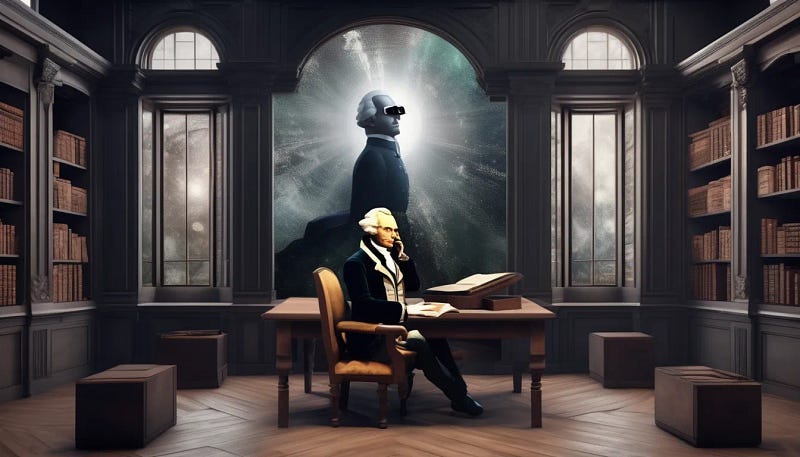
The Simulation Hypothesis, popularized by philosopher Nick Bostrom, posits that our reality could be a sophisticated computer simulation created by an advanced civilization. This idea has profound implications for our understanding of existence, reality, and epistemology. Interestingly, there are philosophical parallels between the Simulation Hypothesis and Immanuel Kant’s concept of “Kantian Humility,” which underscores the limits of human knowledge.
Understanding the Simulation Hypothesis
The Simulation Hypothesis suggests that if it is possible to create a computer simulation so advanced that its inhabitants believe it to be real, and if advanced civilizations are likely to create such simulations, then it is probable that we are living in one. Bostrom’s argument is based on the following premises:
- Any civilization reaching a posthuman stage would have immense computational power.
- Such civilizations would likely run simulations of their ancestors.
- If these simulations are numerous, the probability that we are living in one is high.
This hypothesis raises questions about the nature of reality and our ability to discern the “true” nature of our existence.
Kantian Humility: The Limits of Human Knowledge
Immanuel Kant, an 18th-century German philosopher, argued that human knowledge is inherently limited. In his “Critique of Pure Reason,” Kant introduces the idea of phenomena (the world as we experience it) and noumena (the world as it is in itself). According to Kant, we can never truly know the noumenal world; we can only know the phenomena shaped by our sensory and cognitive faculties. This perspective is often referred to as “Kantian Humility.”
Kantian Humility asserts that there are aspects of reality that are fundamentally beyond our grasp. Our understanding is limited to the representations our mind constructs from sensory input, not the actual nature of things themselves.
Connecting the Dots: Simulation Hypothesis and Kantian Humility
The Simulation Hypothesis and Kantian Humility converge on the idea that our perception of reality may not be the ultimate reality. Here’s how they relate:
Epistemic Limits:
- Simulation Hypothesis: If we are living in a simulation, our understanding of the universe is limited by the parameters set by the simulators. The “true” nature of reality — whether it involves higher-dimensional beings or complex algorithms — remains hidden from us.
- Kantian Humility: Kant argues that our knowledge is limited to how things appear to us (phenomena), not how they are in themselves (noumena). Similarly, in a simulated reality, we only perceive what the simulation allows.
Perception of Reality:
- Simulation Hypothesis: Our perceived reality is a construct, potentially manipulated or designed by an external intelligence.
- Kantian Humility: Our perceived reality is constructed by our sensory and cognitive faculties, which filter and shape our experiences.
Implications for Human Knowledge:
- Both frameworks suggest a profound humility in the face of the ultimate nature of reality. Whether through the technological constraints of a simulation or the cognitive constraints described by Kant, our quest for ultimate truth is inherently limited.
Philosophical Inquiry:
- The Simulation Hypothesis revitalizes Kantian themes in contemporary discourse. It challenges us to reconsider the extent and limits of human knowledge in an age where digital realities are increasingly sophisticated.
The Simulation Hypothesis and Kantian Humility both emphasize the limitations of human knowledge regarding the ultimate nature of reality. They invite us to acknowledge that our understanding of the universe might be constrained, whether by the parameters of a simulated environment or by the inherent limits of our cognitive faculties. This convergence highlights a critical philosophical humility — recognizing that there may always be aspects of existence that remain beyond our comprehension.
Further Reading
- Nick Bostrom’s Original Paper on the Simulation Hypothesis: Are You Living in a Computer Simulation?
- Immanuel Kant’s “Critique of Pure Reason”: Stanford Encyclopedia of Philosophy: Kant’s Critique of Metaphysics
- Philosophical Discussions on Simulation and Reality: Philosophy Now: The Simulation Hypothesis
By exploring these resources, you can delve deeper into the fascinating intersections of modern and classical philosophical thought.
Like My Work? Want an Easy Way to Support Me?
Hi there! If you’ve enjoyed my work why not click the link below and Buy Me A Coffee? It’s simple and coffee keeps my creative and intellectual juices flowing!
Just click on the button below and it’ll take you to my Buy Me A Coffee page. Thanks so much for reading and supporting me!