
Beyond the Shadows: Unveiling the Mystical Secrets of Plato’s Cave and the Hidden Realities of Simulation Theory
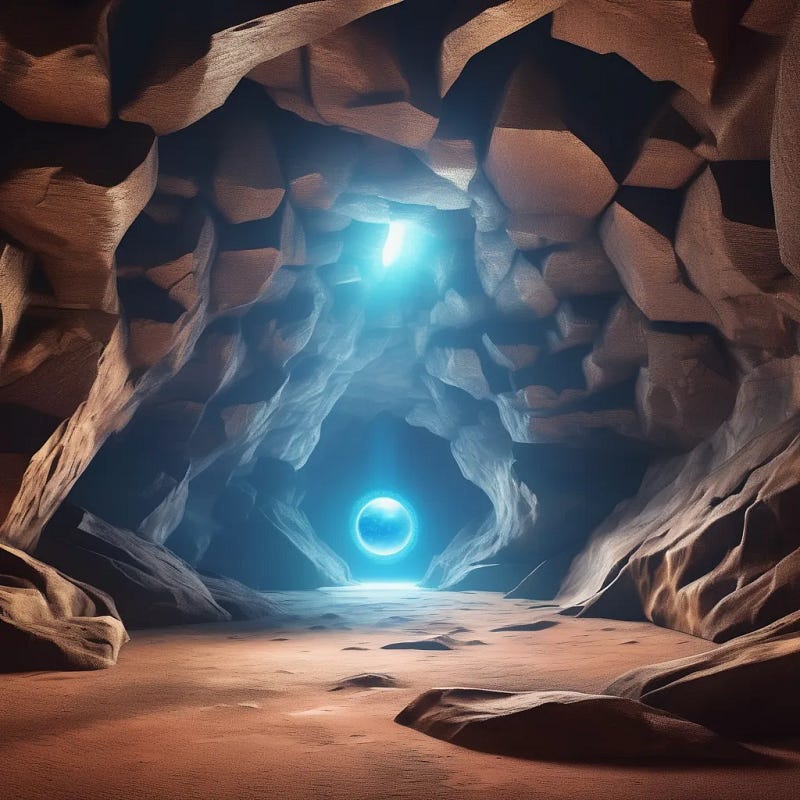
Plato’s Allegory of the Cave, presented in his work “The Republic,” offers a profound metaphor for the human condition and our understanding of reality. It depicts prisoners chained inside a cave, only able to see shadows cast on a wall by objects behind them. These shadows constitute the prisoners’ entire perception of reality. The allegory suggests that most people live in a state of ignorance, mistaking shadows for the true forms of things. The journey out of the cave and into the sunlight symbolizes the philosopher’s ascent to knowledge and the realization of the Forms, which are the ultimate truth and reality.
Esoteric Interpretation of Plato’s Cave
The esoteric interpretation of Plato’s Cave delves into the mystical and hidden meanings of the allegory. Esotericism often involves the pursuit of spiritual knowledge and inner enlightenment, emphasizing that true understanding comes from within. In this context, the cave represents the material world and the shadows symbolize the illusions and misconceptions that cloud human perception.
The journey out of the cave is not just an intellectual pursuit but a spiritual awakening. The sun outside the cave represents the Form of the Good, the ultimate source of truth, wisdom, and enlightenment. This journey is akin to the process of initiation in many esoteric traditions, where the seeker undergoes a transformation and achieves a higher state of consciousness.
Connection to Simulation Theory
Simulation Theory posits that reality as we know it could be an artificial simulation, similar to a sophisticated computer program. This theory has gained traction in recent years, with proponents like philosopher Nick Bostrom and tech entrepreneur Elon Musk suggesting that our universe might be a simulated reality created by a more advanced civilization.
At first glance, Plato’s Cave and Simulation Theory might seem to be addressing different issues: one is a metaphor for ignorance and enlightenment, and the other is a hypothesis about the nature of reality. However, both share a fundamental similarity: the idea that our perceived reality is not the true reality.
In Plato’s allegory, the prisoners’ reality is a mere shadow of the true forms. Similarly, in Simulation Theory, our perceived universe could be a mere facsimile of a more fundamental reality. Both perspectives challenge us to question our assumptions about what is real and to seek deeper truths.
Wisdom Beyond the Simulation
Exploring the intersection of Plato’s Cave and Simulation Theory leads us to profound philosophical questions about the nature of reality, knowledge, and existence. If our reality is a simulation, what lies beyond it? What is the nature of the entities that created the simulation? These questions echo the philosopher’s quest to understand the Forms and the ultimate nature of the Good.
The wisdom that can be derived from these explorations is twofold. Firstly, it encourages intellectual humility. Recognizing the limitations of our perceptions and the possibility that our reality might be an illusion prompts us to remain open-minded and skeptical of easy answers. Secondly, it underscores the importance of seeking deeper truths and understanding. Whether through philosophical inquiry, scientific investigation, or spiritual practice, the journey towards enlightenment and truth is a central human endeavor.
In conclusion, the esoteric secrets of Plato’s Cave and the insights from Simulation Theory both urge us to transcend the superficial and to strive for a deeper understanding of reality. They remind us that what we perceive may only be a shadow of a more profound truth, and that the pursuit of wisdom is a timeless and universal quest.
Like My Work? Want an Easy Way to Support Me?
Hi there! If you’ve enjoyed my work why not click the link below and Buy Me A Coffee? It’s simple and coffee keeps my creative and intellectual juices flowing!
Just click on the button below and it’ll take you to my Buy Me A Coffee page. Thanks so much for reading and supporting me!