
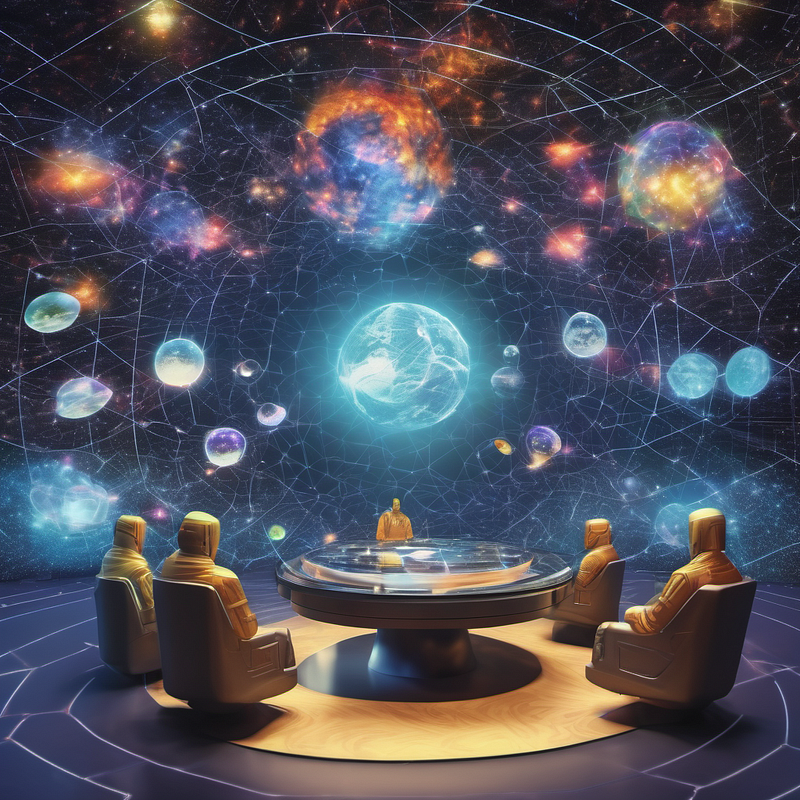
In the realm of science fiction and philosophical speculation, few concepts tantalize the mind as much as the possibility that our reality is not the prime one but merely a layer within an immense stack of simulations. This intriguing notion, often visualized as a cosmic matryoshka doll of realities within realities, suggests that if we occupy the lowest rung of civilization’s ladder, it could very well be that we exist within a simulation created by another, which in turn exists within its own precursor, ad infinitum, until one reaches the elusive base reality. This article delves into the rationale behind this fascinating idea, exploring its technological, statistical, and philosophical underpinnings.
The Seeds of a Simulated Universe
The genesis of this hypothesis lies in the remarkable trajectory of our technological progress. With each passing year, virtual reality becomes more immersive, and computational power skyrockets, leading to simulations that are increasingly complex and lifelike. The logical extension of this trend posits that eventually, creating a simulated reality that is indistinguishable from our own will not only be possible but inevitable.
The Argument from Probability
Central to the simulation argument is a statistical perspective: if an advanced civilization has the capability to create numerous indistinguishable simulations, the sheer number of simulated universes would vastly outnumber the original reality. Consequently, from a probabilistic standpoint, it is more likely for any conscious being to exist within one of these numerous simulations rather than in the base reality itself.
Nested Simulations and the Infinite Regress
The concept of nested simulations introduces an exponential layering to this philosophical puzzle. Should a simulated civilization reach a point of technological maturity, it too could start simulating its own realities. This potential for simulations within simulations creates an infinite regress, a never-ending tower of virtual worlds, each spawned within the confines of another.
Philosophical and Scientific Implications
This hypothesis does more than blur the lines between reality and simulation; it forces us to reconsider the very nature of existence and consciousness. Philosophically, it echoes age-old skepticism about the nature of reality, reminiscent of Plato’s allegory of the cave or Descartes’ musings on the deceiving demon. Scientifically, it poses a formidable challenge: the quest for empirical evidence to support or refute the existence of a base reality.
The Quest for Base Reality
Identifying the base reality among an infinite regress of simulations presents a paradoxical challenge, akin to searching for the foundation stone of an endless tower. This pursuit, however, is not merely an academic exercise. Understanding whether we live within a simulation has profound implications for our understanding of the cosmos, the laws of physics, and the ultimate nature of existence.
While the hypothesis of a simulated reality nested within an infinite regress of simulations remains a speculative venture, it opens up vast territories for philosophical inquiry and scientific exploration. It challenges us to question the very fabric of our existence and to ponder our place within the cosmos. Whether we ever manage to untangle the labyrinth and discern the nature of base reality, the journey through these conceptual realms promises to be as enlightening as it is bewildering.
Like My Work? Want an Easy Way to Support Me?
Hi there! If you’ve enjoyed my work why not click the link below and Buy Me A Coffee? It’s simple and coffee keeps my creative and intellectual juices flowing!
Just click on the button below and it’ll take you to my Buy Me A Coffee page. Thanks so much for reading and supporting me!