
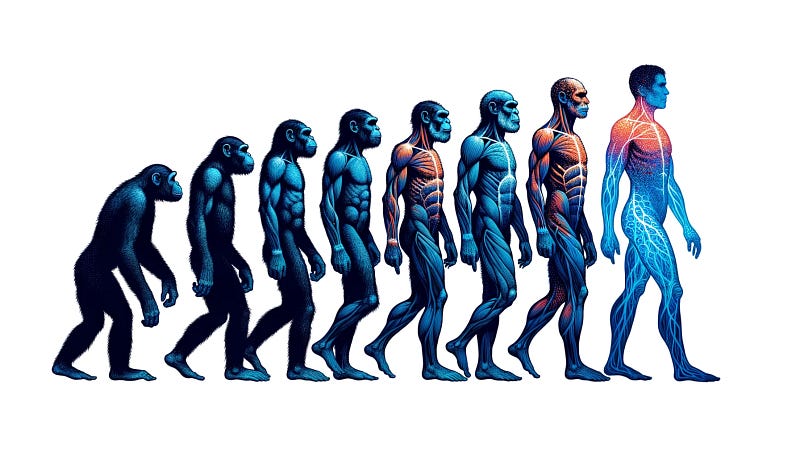
The story of human evolution is one marked by constant adaptation and transformation. From our early ancestors who roamed the African savannas to modern Homo sapiens, who traverse the digital landscape with ease, humans have always been defined by their ability to change. Now, on the cusp of a new era, humanity stands at the threshold of perhaps its most profound metamorphosis yet — from purely biological entities to technologically enhanced beings.
The Path to Enhancement
The trajectory of human progress has been inexorably linked to the tools and technologies we have developed. Fire allowed us to cook food and ward off predators; the wheel enabled the transportation of goods and people over great distances. With each technological leap, we have expanded our capabilities and adapted our biology to new challenges.
In the modern age, this interplay between biology and technology has accelerated. Medical advances have already begun to enhance the human body. Prosthetics restore lost functions, while implants can deliver drugs or monitor medical conditions. Genetic engineering holds the promise of eradicating hereditary diseases and perhaps even enhancing physical and cognitive abilities.
The Next Leap: Transhumanism
Transhumanism is the philosophical and social movement that advocates for using technology to enhance human physical and cognitive abilities. The aim is not merely to repair or restore but to surpass the limitations of our biological heritage.
Cognitive Expansion
One of the most anticipated advancements is in the realm of cognitive enhancement. Brain-computer interfaces could expand our intellectual capabilities, allowing for faster processing of information, enhanced memory, and direct interfacing with digital environments. With augmented intelligence, humans could solve complex problems with greater efficiency, potentially leading to a renaissance of innovation and creativity.
Physical Transformation
On the physical front, bioengineering could lead to stronger, more resilient bodies. Through a combination of genetic modifications and nanotechnology, we might develop resistance to diseases, slow the aging process, and even adapt to previously uninhabitable environments. Such enhancements could be crucial as humanity explores the possibility of living on other planets.
Psychological Adjustments
Enhancements could also extend to the psychological domain. Techniques to manage emotional wellbeing might lead to more stable and resilient individuals. Stress, which is a major cause of health problems today, could be mitigated through neuromodulation, leading to a healthier and more productive society.
The Benefits of Evolutionary Enhancement
Health and Longevity
Enhanced humans could enjoy vastly extended healthspans, not just lifespans. The focus would shift from treating illness to maintaining wellness. With fewer resources spent combating disease, society could allocate more towards education, the arts, and scientific research.
Environmental Adaptability
As the effects of climate change become increasingly apparent, enhanced humans might be better equipped to adapt to extreme conditions. Genetic and cybernetic augmentations could allow for survival in hotter climates or in altered atmospheres, helping humanity to withstand the challenges of an evolving planet.
Cosmic Citizens
Space exploration and colonization have always been limited by our biological constraints. Enhanced humans could withstand the rigors of space travel, survive in low-gravity environments, and perhaps even live on other planets without the need for bulky and expensive life-support systems.
Ethical and Social Considerations
It’s crucial to address the ethical and social implications of such a transformation. Equality of access to enhancements, the definition of what it means to be human, and the potential for new forms of discrimination must be thoroughly debated and legislated. Ensuring that enhancements benefit all of humanity, not just a privileged few, will be one of the greatest challenges of this new phase of evolution.
The evolution of mankind from biological beings into enhanced forms represents the next frontier of human development. While there are undoubtedly challenges and risks associated with this transformation, the potential benefits — longer, healthier lives, greater intellectual capabilities, and the ability to adapt to new environments — could significantly advance the state of humanity. As with any evolutionary change, it will be the collective decisions of society that determine the direction and outcomes of this transition, ideally leading to a future where enhancement technologies are used ethically and equitably to uplift all of humankind.
Like My Work? Want an Easy Way to Support Me?
Hi there! If you’ve enjoyed my work why not click the link below and Buy Me A Coffee? It’s simple and coffee keeps my creative and intellectual juices flowing!
Just click on the button below and it’ll take you to my Buy Me A Coffee page. Thanks so much for reading and supporting me!