
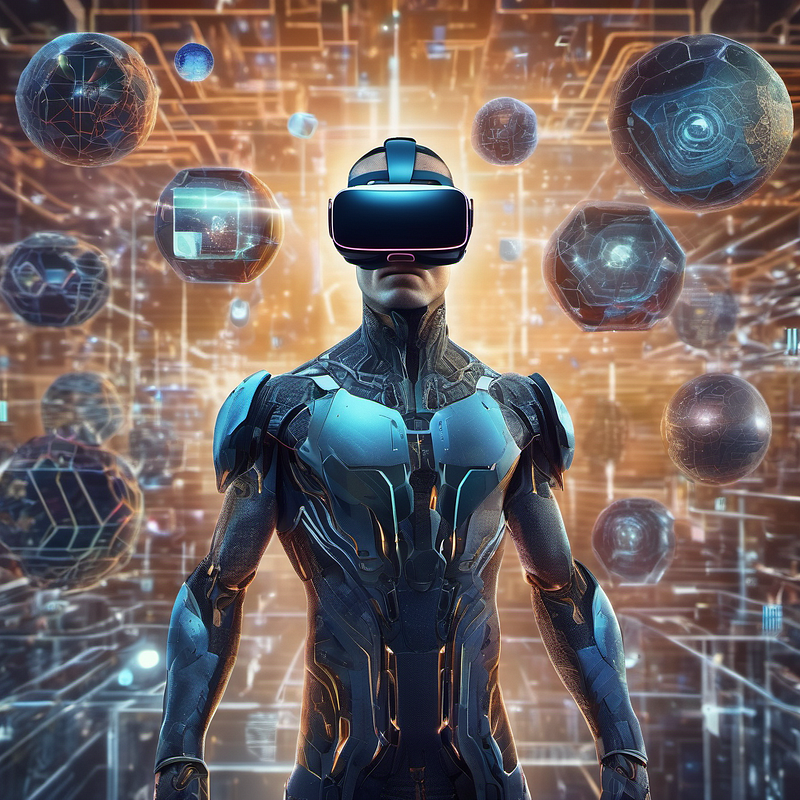
In the realm of contemporary scientific and philosophical discourse, two intriguing concepts have been gaining increasing attention: transhumanism and the simulation hypothesis. While seemingly disparate at first glance, these ideas intersect in fascinating ways, offering profound insights into the potential trajectory of human evolution and the nature of reality itself.
Transhumanism, at its core, is a movement that advocates for the enhancement of human capabilities through the application of advanced technologies. It envisions a future where humanity transcends its current biological limitations, achieving augmented intelligence, longevity, and even physical immortality. Proponents of transhumanism believe that through the integration of emerging technologies such as genetic engineering, artificial intelligence, and cybernetics, humans can evolve into a new species capable of extraordinary feats beyond the scope of our present understanding.
Central to transhumanist philosophy is the concept of morphological freedom, which asserts that individuals should have the right to modify their bodies and minds according to their own desires and preferences. This ethos encompasses a wide range of potential enhancements, from cognitive enhancements that enhance memory and intelligence to biomedical interventions that extend lifespan and mitigate age-related ailments.
The simulation hypothesis, on the other hand, posits that reality as we perceive it may be an artificial construct, akin to a sophisticated computer simulation. This conjecture, popularized by philosophers like Nick Bostrom, suggests that highly advanced civilizations could possess the technological capability to create simulated universes inhabited by conscious beings. According to this hypothesis, our own reality may be one such simulation, with the experiences and perceptions of individuals merely manifestations within the simulated environment.
At first glance, the connection between transhumanism and the simulation hypothesis may not be immediately apparent. However, upon closer examination, it becomes clear that these two concepts share fundamental underlying themes and implications.
One point of convergence lies in the idea of transcending physical limitations. Transhumanism seeks to overcome the constraints imposed by our biological bodies through technological augmentation, while the simulation hypothesis implies that our reality is subject to manipulation by entities possessing advanced technological prowess. In both cases, there is an implicit acknowledgment of the potential for humanity to transcend its current state through the mastery of technology.
Moreover, both transhumanism and the simulation hypothesis challenge traditional notions of identity and consciousness. Transhumanist enhancements have the potential to blur the boundaries between human and machine, raising questions about what it means to be human in an increasingly technologically mediated world. Similarly, the simulation hypothesis suggests that our perceptions of self and reality may be illusory constructs, prompting a reevaluation of our understanding of consciousness and existence.
The intersection of transhumanism and the simulation hypothesis also raises profound ethical and existential questions. As we contemplate the possibility of manipulating reality through technology, we must grapple with issues of control, autonomy, and the implications of playing “god.” Additionally, the prospect of living in a simulated reality challenges our notions of agency and purpose, prompting us to reconsider the nature of free will and the meaning of our existence within the confines of a potentially artificial construct.
In conclusion, the convergence of transhumanism and the simulation hypothesis offers a thought-provoking glimpse into the future of humanity and the nature of reality. By exploring the intersections between these two concepts, we gain valuable insights into the potential trajectory of human evolution, the ethical implications of technological advancement, and the fundamental questions that lie at the heart of our existence. As we continue to navigate the complexities of an increasingly technologically driven world, the dialogue between transhumanism and the simulation hypothesis serves as a compelling lens through which to explore the frontiers of human potential and the mysteries of the universe.
Like My Work? Want an Easy Way to Support Me?
Hi there! If you’ve enjoyed my work why not click the link below and Buy Me A Coffee? It’s simple and coffee keeps my creative and intellectual juices flowing!
Just click on the button below and it’ll take you to my Buy Me A Coffee page. Thanks so much for reading and supporting me!