
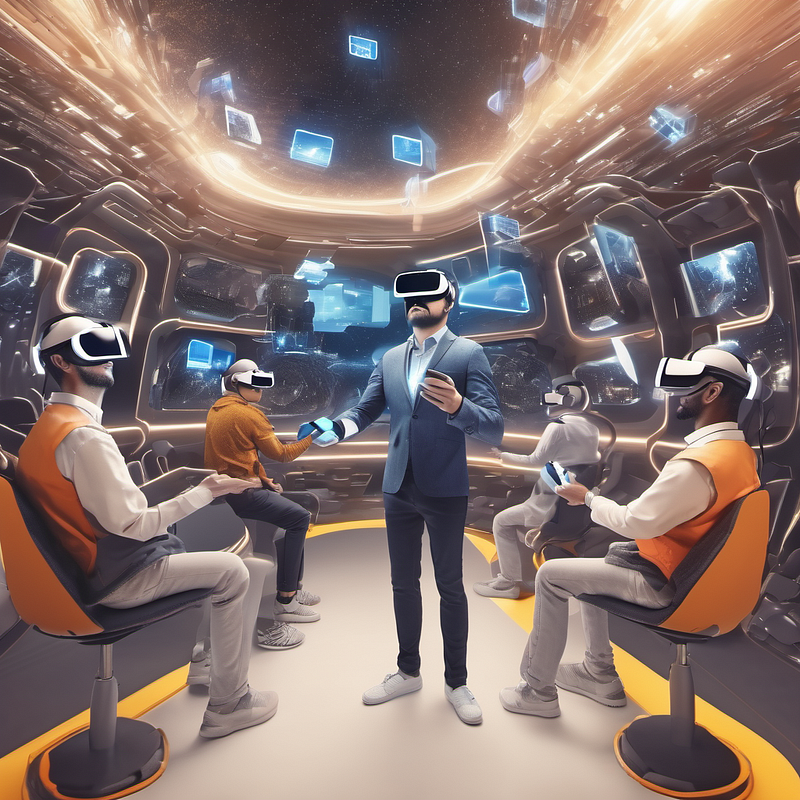
In the age of rapid technological advancement and philosophical inquiry, the question of humanity’s place in the universe has taken on new dimensions. Among the myriad theories seeking to explain our reality, the simulation hypothesis has emerged as a provocative and compelling concept. While the notion of living in a simulated reality may initially seem far-fetched, upon closer examination, it offers intriguing insights that challenge our traditional understanding of existence.
The simulation hypothesis posits that our perceived reality is actually a sophisticated simulation created by advanced beings or entities. In this scenario, everything we perceive as the physical world — from the laws of physics to the intricacies of human consciousness — is simulated within a computer-like system. While the idea may sound like science fiction, proponents argue that advancements in technology and computational power make the concept increasingly plausible.
One of the key arguments in favor of the simulation hypothesis is the rapid pace of technological progress observed in our own society. From the development of virtual reality to the rise of artificial intelligence, we are continually pushing the boundaries of what is possible in the realm of simulation and computation. Given our own trajectory, it’s not unreasonable to imagine that more advanced civilizations could possess the capability to create highly realistic simulated worlds inhabited by conscious beings.
Moreover, the simulation hypothesis provides a compelling explanation for certain phenomena that are difficult to reconcile within the framework of traditional physics. For instance, the apparent existence of fundamental constants and physical laws that govern our universe could be interpreted as artifacts of the underlying simulation code. Likewise, the concept of quantum mechanics, with its inherent randomness and probabilistic nature, could be seen as the result of computational processes at work.
Another intriguing aspect of the simulation hypothesis is its potential to address age-old philosophical questions about the nature of reality and consciousness. If our reality is indeed simulated, what does it mean for the concept of “realness”? Are the experiences and sensations we perceive any less valid simply because they are generated within a simulated environment? These questions challenge us to reconsider our assumptions about the nature of existence and our place in the universe.
Critics of the simulation hypothesis often point to the lack of empirical evidence as a major stumbling block. After all, we currently have no way of conclusively proving or disproving the existence of a simulated reality. However, proponents argue that the absence of evidence does not necessarily invalidate the hypothesis, particularly given the limitations of our current scientific understanding.
While the simulation hypothesis may initially seem like a far-fetched concept, it offers a compelling framework for understanding the nature of reality and our place within it. As we continue to explore the frontiers of technology and philosophy, the idea that we may be living in a simulated reality challenges us to question our assumptions and explore new possibilities. Whether or not the simulation hypothesis ultimately proves to be true, its implications for our understanding of existence are profound and thought-provoking.